
Thank you to the contributors (listed below) for submitting these twenty four suggestions. The most popular will be made into a miniature! Please have a read through them all and have a think about who your favourites are! You will be able to vote for as many as you like, but please only vote for your favourites, IE what you’d REALLY like as a mini.
VOTING WILL OPEN 7PM WEDNESDAY 6th MARCH AND CLOSE 7PM SATURDAY 9th MARCH on our Facebook group
Click here to be taken directly to the poll. Only votes on that will count.
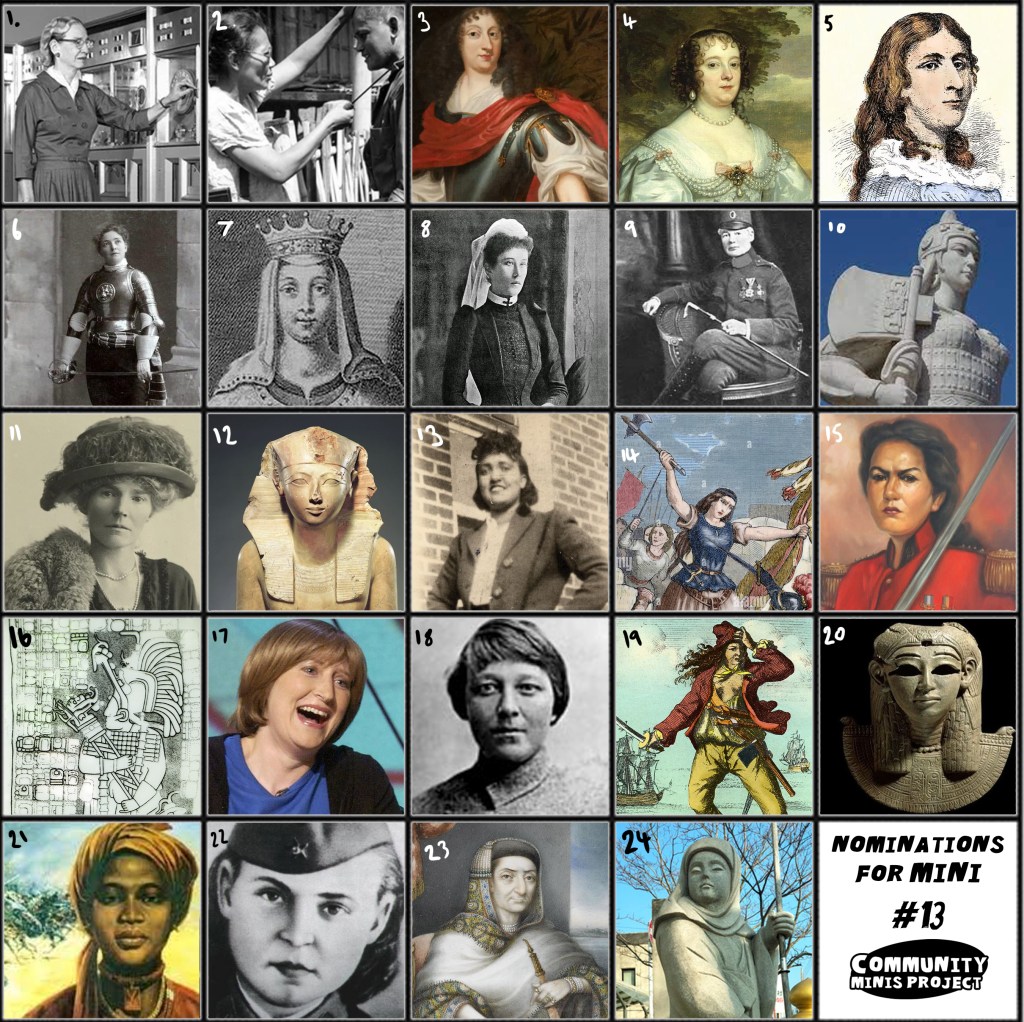
Images: Images are not necessarily how the minis will be dressed, just chosen for an easy glance and public domain, you are encouraged to look up more photos and information, we just haven’t gone in full detail for everyone or it would take a long, long, time!
Notes: Most of the text below is written or sourced by the contributors – you wonderful people via our Facebook group where such decisions take place, some may have more written about them, as that person just submitted more information.
- Admiral Grace Hopper (1906 – 1992) “the grandmother of the computer age” Mathematician and Computer Scientist. Worked on UNIVAC and created the first computer code compiler, without which modern computing could not exist. During WW2, she was told that she was too short, and at 34 too old, to serve in the US Navy. But persisted, secured an exemption, and eventually rose to the rank of Rear Admiral, retiring for a third (and final) time in 1986 as the oldest serving member of the Navy. She was also a teacher and credited with writing the first technical instruction manuals that helped others understand computers.
- Captain Nieves Fernandez (1906-1997) – aka “The Silent Killer” who fought in WW2. Nieves was a school teacher and local businesswoman in Tacloban City, Philippines, who became a legendary resistance fighter after the Imperial Japanese brutalized the people of her town. She organized a guerilla unit that ended up having between 100-200 fighters, and personally killed dozens using a homemade shotgun and her bolo knife. Her trademark tactic was a quick kill with the bolo, earning her the nickname “The Silent Killer.”
- Christina, Queen of Sweden (1626 – 1689), Queen of Sweden from age 6 until her abdication at age 27, after which she lived a life of intrigue in France and Italy. She was known for dressing in masculine clothes, was a patron of the arts, converted to Catholicism and was guest in Rome of successive popes, defended Jews and Huguenots from persecution. She never married and her sexuality is debated.
- Countess Charlotte Stanley (née de La Trémoille) (1599 -1664). French noblewoman who married into an English family before the English Civil War and famously held the line at the Siege of Lathom House and later the Isle of Man, the former being the last Royalist stronghold in Lancashire and the latter being one of the last Royalist holdouts in the British Isles. By all accounts an extremely fierce and intelligent woman, the sort that could hold off armies for months at a time in her husband’s absence.
- Deborah Sampson (1760 – 1826) Served in the AWI under a false name, operated on herself to avoid detection from a surgeon.
- Ella “La Jaguarina” Hattan (1860-19??) aka The Amazon of the Age. USA. An actor trained to fence by Col. Monstery who went on to beat over 60 male opponents in sword combat on foot and horse. When she ran out of worthy adversaries she then had a successful vaudeville career displaying her sword skills, then returned to acting.
- Empress Maude (Matilda) (1102-1167) Queen of England & Normandy, Rightful queen usurped by her cousin
- Ethel St Clair Grimwood, (1867 – 1928) A British woman who became known as “the heroine of Manipur”. is a British lady who became to be known as the Heroine of Manipur in the History of modern Manipur. She is main person behind the devising of plans for the escape of Tikendrajit Singh from the several capture attempts of the British Army. She is the authoress of the “My Three Years in Manipur and Escape from the Recent Mutiny”, published in 1891, the same year of the outbreak of the Anglo-Manipur War.
- Flora Sandes (1876 – 1956) A British nurse who ended up as a Sergeant Major in the Serbian army in WW1. In June 1919 she became Serbia’s first female commissioned officer.
- Fu Hao (around 1200BC) Lady Fu Hao was one of the 60 wives of Emperor Wu Ding of ancient China’s Shang Dynasty. She broke with tradition by serving as both a high priestess and military general. According to inscriptions on oracle bones from the time, Fu Hao led many military campaigns, commanded 13,000 soldiers and was considered the most powerful military leaders of her time. The many weapons found in her tomb support Fu Hao’s status as a great female warrior. She also controlled her own fiefdom on the outskirts of her husband’s empire.
- Gertrude Bell (1868 – 1926). A true adventurer in parts of the world where men often feared to tread. For and against causes often at the same time but wise enough to see the need to think far into the future for what a people need and sane enough to see the need to see a people and not just maps and statistics. She crossed the laths of Churchill and Lawrence and both had to admit respect for her. She spent her life trying to be her own woman and believed women could be whatever they wanted to be (without the vote – at first, at least – the perils of privilege, as I say) and died as miserably and forthrightly as she had lived. Always fascinated me and struck me as a wonderful example of how posh ladies could be every bit as barmy and adventurous as posh men if everyone just let them get on with it and allowed them to be the people they could be. She would have been a celebrity and a pundit and an icon today. A contrarian powerhouse of passions. An inspirational figure.
- Hatshepsut (1479 – 1458 BC). Egyptian queen regent/pharaoh. There is evidence that Hatshepsut led successful military campaigns in Nubia, the Levant, and Syria early in her career. The conquered lands being taxed and looted made Egypt rich.
- Henrietta Lacks (1920 – 1951). African American housewife who passed away of cancer. Her cells were taken during a cervical tumor biopsy without her permission (which was legal at the time, but is highly controversial for a few reasons). For some unknown reason, her cancer cells had a high reproduction rate without dying, which was unheard of. This cell line, known as the HeLa line, allowed scientists to conduct research that was impossible before, and led to the development of the Polio, COVID-19, and HPV vaccines. HeLa cells are also used for cancer, AIDS, and genome/chromosome mapping. More than 70 years later (2023), her family has finally settled a lawsuit against medical companies, which have made billions off of Henrietta’s cells with zero compensation. I feel like Henrietta deserves a mini, as she was a woman who *everyone* alive benefits from, but has no idea about. She was more than just cells, and she deserves to be seen as a whole human.
- Jeanne Hachette (1454 – ????) An emblematic figure in the history of the French city of Beauvais’ resistance to the siege laid by Charles the Bold, Duke of Burgundy. She is said to have helped to repel a Burgundian attack on the town of Beauvais with a hatchet and, in popular history, has been elevated to the rank of French heroine. During a Burgundian attack on July 22, Jeanne Laisné is said to have wielded an axe in order to push back a Burgundian who had planted a flag upon the battlements. Axe in hand, Jeanne flung herself upon him, hurled him into the moat, tore down the flag, and revived the flagging courage of the defenders
- Juana Azurduy de Padilla (1780 – 1862) She fought for Bolivian and Argentine independence alongside her husband, Manuel Ascencio Padilla, earning the rank of Lieutenant Colonel. She was noted for her strong support for and military leadership of the indigenous people of Upper Peru. Today, she is regarded as an independence hero in both countries. Famously fought a battle while pregnant and later continued the campaign with her child on her back.
- Lady Kʼawiil Ajaw (617-682), Ruler of Cobá, Mayan city state, for over 40 years. Although not the first female ruler of Cobá, she was one of the most powerful. She bore the title kaloomteʼ (‘superior warrior’), which was a very high title in contemporary Maya culture, and not worn by all rulers. She commissioned the longest road on Mayan history, the Coba-Yaxuna Sacbe (white road), a feat considered on par with the Mayan pyramid. A 62 mile road that connected Cobá to Yaxuná and intermediate towns and villages, it always likely an attempt to establish control over the centre of the peninsula.
- Linda Smith (1958 – 2006). Comedian and President of the British Humanist Association – 2002 “Wittiest Living Person”. Linda started her career touring a show Token Women and doing benefit gigs for miners during the miners strike. She went on to become one of the stalwarts of British Radio and Television comedy until her untimely death from ovarian cancer at 48.
- Maria “Marusya” Nikiforova (1885-1919) Ukrainian anarchist, commander of a large chunk of the Revolutionary Insurgent Army of Ukraine during the Russian Civil War, more famous than Nestor Makhno was at the time, bank robber, terrorist, revolutionary, fierce fighter for freedom and liberty of the oppressed and the workers.
- Mary Read (unknown –1721), fictionally known as Mark Read, was an English pirate about whom there is very little factual documentation. She and Anne Bonny (who won the last round) were two famous female pirates from the 18th century, and among the few women known to have been convicted of piracy at the height of the “Golden Age of Piracy”.
- Queen Amanirenas of Kush. (DoB is vague but reigned Kush between 40-10BCE) Halted the Roman empire’s expansion into Africa.
- Sarraounia Mangou (late 19th Century) – African warrior queen of the animist Azna subgroup of the Hausa, who fought French colonial troops of the Voulet–Chanoine Mission at the Battle of Lougou (in present-day Niger) in 1899.
- Senior Sergeant Mariya Sergeyevna Borovichenko (1925 – 1943) During WW2 fell in with the 5th Airborne Brigade where she was accepted into service as a field medic because of her nursing background. Fighting at Konotop during the Kiev encirclement she noticed the Germans attempting to rush infantry across a damaged railway bridge. Realising that would cut off the brigade she helped drag a Maxim into action and acted as spotter and loader. This delayed the enemy allowing the brigade to fight them off and escape the larger encirclement. After this she continued to serve when the survivors of the brigade were reformed into the 87th Rifle Division and was then awarded Guards status as the 13th Guards Rifle Division. She was featured in the newspapers when on a scouting mission she was responsible fir the capture of ten enemy soldiers. She continued to serve with the division fighting at Stalingrad and at Kursk where she was killed by an exploding tank shell as she covered one of her patients from enemy fire.
- The Begum Samru / Joanna Nobilis Sombre / Farzana Zeb un-Nissa (1753 – 1836) India, ruler of Sardhana, only native Catholic ruler, Was a young wife of a Swiss mercenary general in India, who died. She took over his kingdom and his army, and ruled them for almost 60 years, including leading them into battle (on horseback). Her army fought against Arthur Wellesley (later Duke of Wellington) at the Battle of Assaye, his first major victory (her wing was the best part of the army he beat – although it’s not entirely clear if she was there, but hey)! She was only 4 1/2 feet tall. There’s an awesome painting of her whole army on parade, with her on elephant back. I really want the tiny Indian warrior queen.
- Yoshioka Myōrinni, (16th century Japan), She was a warrior nun and military leader and strategist who was instrumental in securing victory for the Ōtomo clan over an invasion by the Shimazu in 1586–1587, first organising castle defense and training all the inhabitants to fight and then organising and leading raids and field battles that turned the tide of the war. While there is no image of how she looked in life, there is a statue honouring her in Oita City with her Buddhist robes and naginata for sculpting inspiration, perhaps in a more active combat pose.
Thanks to the contributors: In no particular order…Gregg Cabe Bond, John Cunningham, Will Bailie, Myles Howard, Adam Carriere, Phil Crawley, Chris Cooper, Chris Loisel, Christopher Downes-Ward, Nick Cooper, Andrew Fachau, Dan McLaughlin, Ian Brumby, Hannah Walter, David Themistocree, Phil Leedell, Peter Melvin, Anthony Waddington, Felicity MacLeod Cullen, Alistair Thompson, Andy Banks, Alex Wood, Jamie N. Bunni Fishwick-Ford, & Cat O’Mighty
After this miniature, the Community Minis Project is getting a massive revamp to make it easier for everyone, so keep an eye out for that. I’m also intending to make a survey to gather your thoughts on the project so far.
 Community Miniatures Project