
I’m starting to believe that there’s a conspiracy in the results of the Community Miniatures Project to get me to learn about as many times and places as possible. How dare! What I actually mean is – thank you! While it’s a lot, cramming research for these minis has really helped build up my historical knowledge, which, as I have mentioned before – is full of gaps. This time we’re in the early medieval era, sometimes called the “Viking Age”, something we’ve covered a lot. Neato. Familiar. Until I realise we’re further East in this period than I know about. Time to get-a-learnin’!
When I first learnt of Olga, actually through the nominations for this project, I was incredibly excited. I was also shocked I had never heard such a legendary story before, and was rooting for her to win, so I’m more than happy that she did. Yesssss flaming pigeons (spoiler). I expected there to be a whole heap of books and resources but actually quite quickly hit a wall.
Perhaps due to the age, or there being little written or translated into English, I couldn’t find many sources at all. Most were various blog rewrites based on each other. At time of writing this, I’m still researching. The main writing I came across was the Primary Chronicle which is thought to be written in the 1100s and covers Kyivan Rus’ from around 850 until 1100.
Olga’s birth date is unknown, estimated to be between 890 and 925 CE and she lived until 969 CE in Kyivan Rus’. This was an area which covered areas now called Ukraine, Western Russia and Belarus. While young, she was married to Prince Igor of Kyiv, and following his death, took control as regent until their son Sviatoslav was of age.
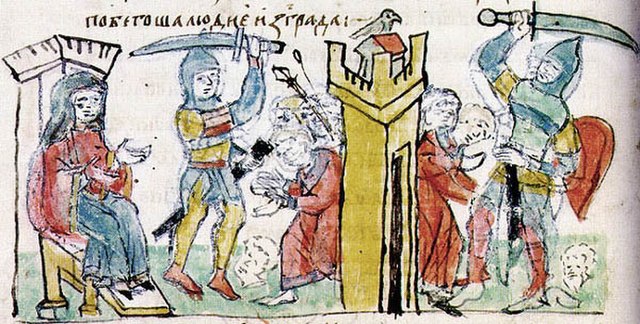
As part of an ongoing feud with the Drevlians (a nearby tribe), Igor was eventually “captured by them, tied to tree trunks, and torn in two.” This set a chain of cunning and violent revenge from his widow that would cause much more horrific bloodshed.
The Radziwiłł Chronicle is a later copy of the Primary Chronicle, with more added to it, and has a whole heap of illustrations. As a fan of the style of medieval manuscript, this does not disappoint. I like to narrate them. In the series about Olga, she is usually sat pointing at the events, which I may have mimicked from my office chair. But you can’t prove it! Here she is chilling and saying “ah yes, burn them to death”. If you scroll back up she’s saying – no wait, I can’t tell you that bit yet, it’s for later.

Her story is one of those where it baffles me that it isn’t more well known. Even from the cold commercial point of view – it would make a brilliant TV series or film. In a talk recently I mentioned truth being stranger than fiction, and this is one where you don’t need to make it up – as you have it here ready to go! Chronicled!
Perceiving a weakened widow, the Drevlians offered to marry to her to their own prince, Prince Mal. She replied enthusiastically, of course she would, she can’t just be floating around unmarried after all and she was now a free lady! She specified that they must come via boat, and would be carried by her people as an act on honour. How lovely.

When they arrived, they were indeed all lifted up, which must have been a nice treat. However they were then tipped into a pre-dug hole and buried alive. Oops.
Her justification was that they didn’t send particularly high ranking or “cool enough” men, so they should do that and then she will totally comply. Totally. Upon arrival she had them led into a bathhouse for a nice scrub, which was then locked and set on fire. What’s the old saying – fool me once, shame on you, fool me twice….won’t get fooled again?
Still, they agreed to her third demand, which was a mighty feast where she could weep over the tomb of her husband, and finally accept that she had to remarry. Psyche! After they were all drunk on mead, her people killed around five thousand of theirs.
You’d think after this, that all pretence would be expired. But you’re already admiring this BEAUTIFUL collage I just made, and thinking that perhaps that cannot be the case. An attack on Iskorosten was declared by her young son, Sviatoslav, who feebly threw a spear (bless him!) towards the Drevlian forces on her command; this siege lasted a year.
After the year, she said, “Ok, here’s the deal. You just need to pay us tribute. All we want is three pigeons and three sparrows from each household, and that’ll be fine.” Presumably forgetting not to trust this lady at all, they complied. Seems reasonable enough!

“Annie, why have you collaged a pigeon flying in fire, whilst also carrying some fire?” Just normal reasons. They gave her the birds and off she went, it was all fine. Nobody die- ok fine, lots of people died. Each pigeon and sparrow had a little piece of sulphur and cloth tied to it’s little leg and set free. Yay! Of course they are homing animals, so off they go back to the city to go nest in all the lovely flammable hay and yes the whole place is on fire.
These intros to the Community Miniatures are supposed to be, well, intros. Brief. But we’re getting on a bit more so I’ll fast forward. Olga does a lot of work regarding administration, law making and changing the tribute system, which is fascinating in it’s own right, but has no flaming birds.
So, around 950 CE her travels took her Constantinople, where she caught the eye of the emperor, Constantine VII. Olga was still a highly sought after widow, and after many years of dodging proposals, she was running out of excuses. She had Constantine baptise her under the Christian name Helena, and then said oh no we can’t marry now it’s too weird. (The term used is “spiritual incest”)
You’ll have to look up the rest! She was later on made the Patron Saint of Widows and Converts, the former being obvious and the latter due to her vast work spreading the word of Christianity.
Now how the heck are we going to sum all this up in one mini? Stay tuned….
-Annie

 Community Miniatures Project