Mary Read & Anne Bonny Sculpts!

Alan has been very busy, and now we have… some more fantastic pieces of art. He never disappoints. We’ve worked together for…. about nine years so far, and getting the “Alan Marsh has sent you a photo” notification is still as exciting as it was from the first sculpts. Brynhildr was the first he made for us at Bad Squiddo Games, and still one of my favourites.

Are you ready? Here you go…

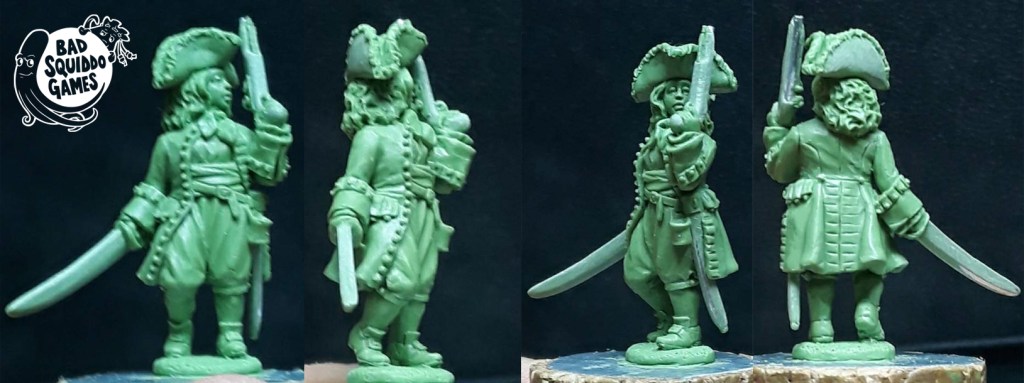
Work in progress sculpts by Alan Marsh – Greenstuff, Milliput, and wire.

Aren’t they adorable?! Ok so they are early work in progress shots. From L-R we have Mary Read, Anne Bonny, parts of weapons (they get sanded down once they’ve dried) and a bonus Olga of Kyiv! Not erally, of course, but that is the beginning of the shoulder pigeons.

Wire is a very important “skeleton” when sculpting anything that will be vulcanized – IE moulded to be cast into metal. The figure has to hold it’s form under a hole heap of heat and pressure (sames) and even the most beautiful sculpt without a solid core will buckle and distort in this process. I’ve seen it- horrifying!

Now to skip a few steps and….. voila!

Mary Read

Beautiful! I was slightly concerned about her in the design stage as she’s more practically dressed for sea than Anne, and I wanted to make sure she was still an interesting and exciting sculpt – she is! It’s so rewarding seeing your designs in reality. Validating, even.

For anybody just finding us here, the sketches and choices behind the designs are here. This project maps out the process from concept to painted, completed mini.

Anne Bonny

Here is Anne, out on the town! Out to… not cause any trouble, honest. You may notice a slight change from the concept art…… her left hand is up instead of lowered. This was on Alan’s suggestion during the early sculpting he said “my bit of wire has an air of sass to it” and who am I to argue with that? It has worked! There’s a small bit of concern about the casting of this but as we speak, Alan and CMA are discussing it and I get to leave them to it. She may need a tweak, but based on the videos I’ve seen from other angles, it might be tricky, but the casters are incredible, so they’ll manage it! (At worst we’ll change the head angle slightly, that’s all)
Conclusion

They’re lovely, aren’t they? I was worried that everything that could be done about pirates has…been done, but it was definitely wrong as these are fresh and unique, and I’m extra pleased that my research has shone out of them, instead of being lazy and just “making some pirates”. There’s reasons behind every part of their dress, it’s all been thought out, and that’s humbly, why I think our minis rock.

When?!

Soon! They will be moulded at the same time as Olga, so she is in progress at the moment, and then she will go to the mouldmaker and casters – I’ll approve the casts at master and production stage, then when everything is groovy they can be spun! The first casts will go to John to be painted, and I’ll get the packaging all sorted. After writing this, I’ll get over to Martin Whitmore to brief him on the card art.

Remember only the first 100 get the Collector Cards, you can pre order them here.

Delivery is looking like late September if not October.

Cheers – Annie
Designing Saint Olga of Kyiv

When I initially read about Olga, my brain demanded flaming pigeons. Now we’re further down the line it – yeah it’s still that. There’s been a pose in mind from the very beginning, but when it comes to what she’s wearing, it’s been somewhat more difficult. To begin, do we put her in armour or a dress? If armour, what sort of armour? I now have a folder full of references of her son Sviatoslav and her husband Igor, as I imagine that if she ever armoured up on the battlefield, she would have worn similar to those two. There are no records I could find of her fighting, but she was there amongst the soldiers, so wearing protective gear just in case doesn’t seem too far a stretch.

However! For this project, the symbolic vengeful queen in gown with flaming pigeons seems better suited, and hopefully, not too far in the future, we can have a bonus Olga fighting with a big old sword and mailled up. If you’re good. By good I mean buy this one, and I’ll consider the latter if she flies off the shelves.

If you haven’t yet, you can read a bit more about her on the research post.

So, how is she portrayed?

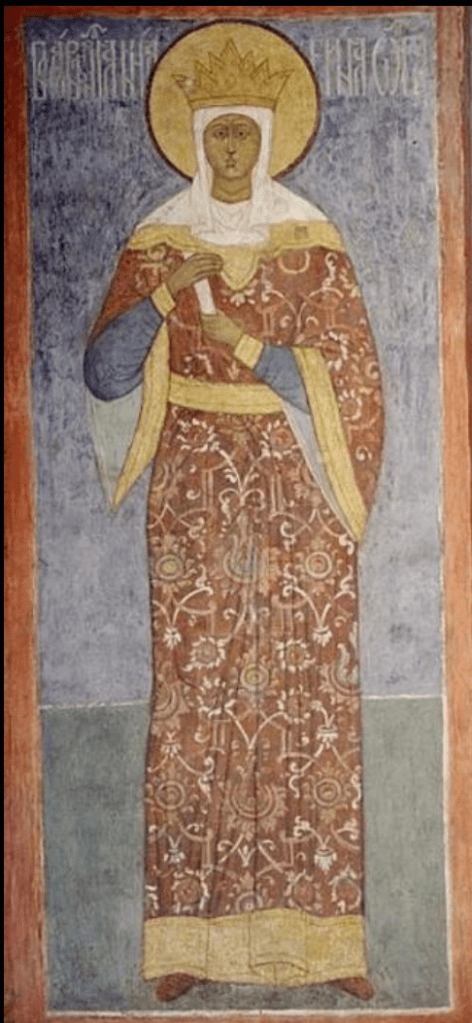
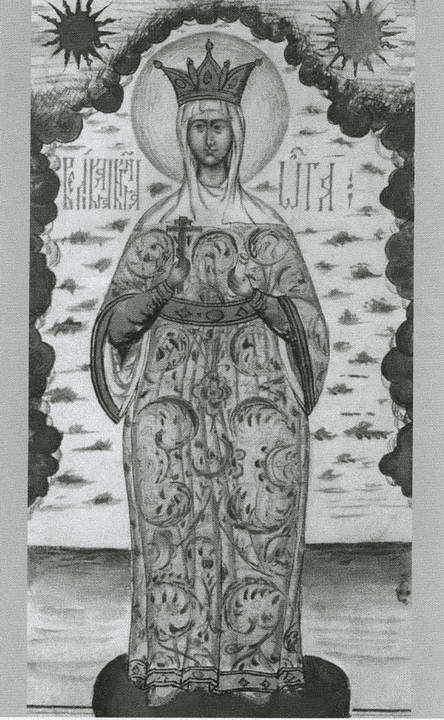
I try to look for sources as contemporary as possible, which has been difficult with this period. As we’ve seen when researching other figures, artists like to add their own flair, which is often reflective of the times in which it was created. However, Olga in a wimple, long gown, tighter undersleeves and a crown is pretty much the iconic gear for so many of her depictions.

Radziwiłł Chronicle. 15th C.

There was a long moment where I was stuck on whether to portray her as Christian or Pagan, especially as I wanted to include the flaming pigeons and sparrows, which was before her conversion. Of all the inspiration in the world, I turned to the wise words of Jez, from British comedy “Peep Show”.

“Uh, yeah, I spent some time with Ray before he went and I just wanted to say that I think we should all remember that Ray, by the end, he loved Jesus. Look, what I’m trying to say is that if I was dying and I decided that even though I’d never particularly been into, say, Enya before but that now I really, really was into Enya and that in fact, I thought Enya was great and that Enya died for our sins and I wanted an Enya themed funeral with pictures of Enya and lots and lots of mentions of Enya, then I think it would be a bit bloody rich for my sister to ban all mention of Enya from my funeral. Yeah?

Ok yeah fair point! The cross it is! There is important symbolism to consider in these miniatures, and the Queen and Saint are two main elements of this for Enya. I mean, Olga.

The Design

Admittedly, this is the most out of my comfort zone I have been so far in the project. It’s become clear to me that it’s such a changing period, not just in fashion but, everything! In fact it was Olga herself, who put many of these wheels in motion.

We’re gonna go for the “something old, something new” theory for design here, as we are combining elements of her pre and post Christianity, which is also a huge change culturally.

I’ve drawn her in a simple gown of two layers, which you can then paint freehand to your heart’s content or(much easier) block in the colour with a bit of a wash over to bring out the folds. Red, blue and green are very strong in the older paintings. I will add in my notes to the sculptor that I wish the wimple, dress and cape to be more blowy in the wind, rather than just hanging there. As is she’s conjuring a storm (which she is, really!)

Pigeons, of course! This will be a fun challenge for Alan (I’m sure I said that last not too long ago, poor Alan) as the mini will be single piece, so he will need to find a way of “attaching” pigeons to her. I know you’re reading this Alan, I have faith in you!

Eastern Orthodox crosses

For the pose, I looked through plenty of spell caster reference photos, and I couldn’t quite get what I wanted, until I remembered the first bit of inspiration – The Night King from Game of Thrones! There’s a particular scene where he raises the dead and the stance is so powerful that I had to! It’s why her expression isn’t shouting, as it’s nicely sinister instead. We have ALL the pop culture references today.

There are lots of jewels to show her status, and a cross, which may end up quite oversized but is an important reference to her beliefs. The Eastern Orthodox cross has a variety of designs that are based on these two shapes. The right version will work better at such a small size.

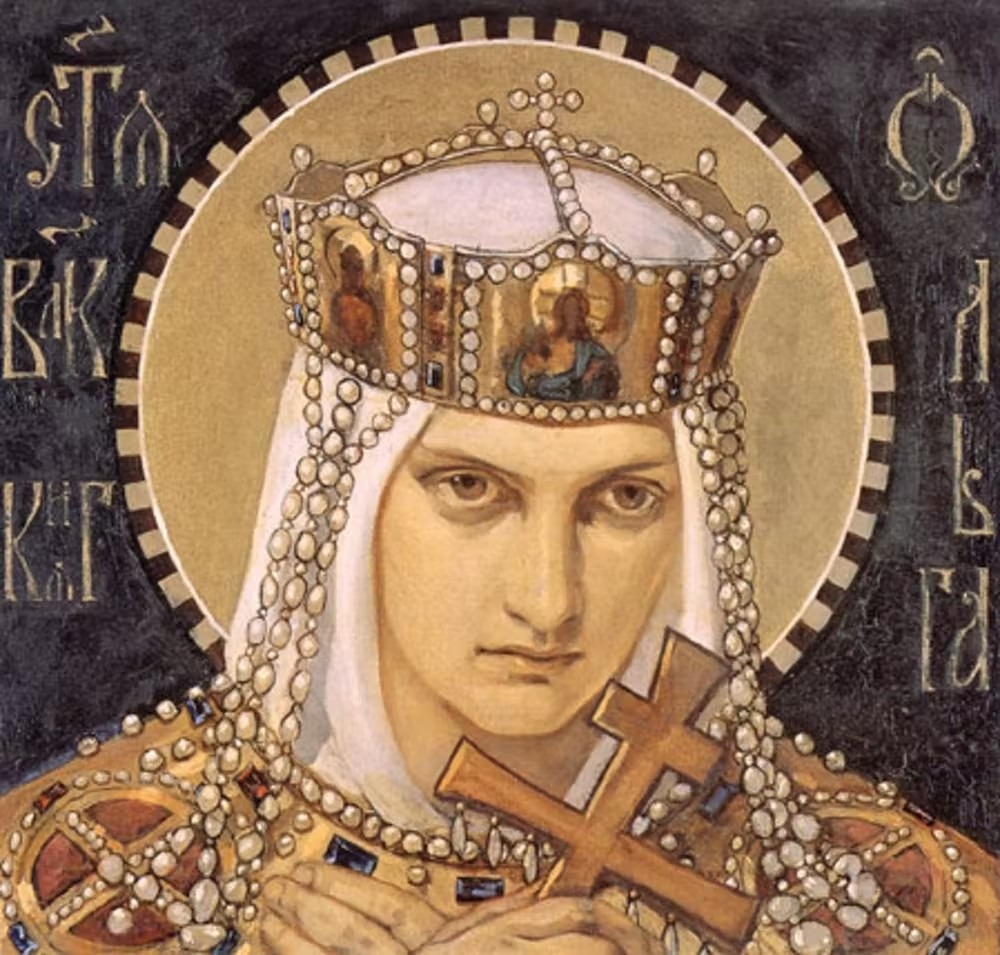
Olga of Kiev by Nikolai Alexandrovich Bruni, 1901

The crown will probably be shortened from the drawing to something like this, from Nikolai Alexandrovich Bruni, which shows the pearls along the top. The “sunken” areas will be much easier to cast than if the rim was taller, and many are familiar with this image. See what I mean with that cold gaze – more effective than a yell. It’s terrifying. I have been told on several occasions that I am capable of such a face, usually when prepping for a big convention. This is clearly untrue.

As a final point – the pigeons won’t have sculpted fire. Nope, nope. I have tried to paint flames coming off minis too often to put that onto you. A flame on a bonfire or torch – yes, but coming from a mini, it often looks just… hairy. They also weren’t on fire when released. BUT. You can paint them fiery or make some neat conversions to add some flames. I won’t tell you off. Or give you the stare.

As I am always looking for as many ways I can sell a people can use a mini, I feel this design makes her a brilliant fantasy spellcaster or leader. Or both!

As always, disclaimer that I am not a historian, nor do I spend extra time getting the drawings perfect, as they only need to be good enough for the sculptor to work with – but I do have heaps of enthusiasm and obsession, so hoorah!

-Annie

Who was Saint Olga of Kyiv?

St Olga by Mikhail Nesterov in 1892, public domain

I’m starting to believe that there’s a conspiracy in the results of the Community Miniatures Project to get me to learn about as many times and places as possible. How dare! What I actually mean is – thank you! While it’s a lot, cramming research for these minis has really helped build up my historical knowledge, which, as I have mentioned before – is full of gaps. This time we’re in the early medieval era, sometimes called the “Viking Age”, something we’ve covered a lot. Neato. Familiar. Until I realise we’re further East in this period than I know about. Time to get-a-learnin’!

When I first learnt of Olga, actually through the nominations for this project, I was incredibly excited. I was also shocked I had never heard such a legendary story before, and was rooting for her to win, so I’m more than happy that she did. Yesssss flaming pigeons (spoiler). I expected there to be a whole heap of books and resources but actually quite quickly hit a wall.

Perhaps due to the age, or there being little written or translated into English, I couldn’t find many sources at all. Most were various blog rewrites based on each other. At time of writing this, I’m still researching. The main writing I came across was the Primary Chronicle which is thought to be written in the 1100s and covers Kyivan Rus’ from around 850 until 1100.

Olga’s birth date is unknown, estimated to be between 890 and 925 CE and she lived until 969 CE in Kyivan Rus’. This was an area which covered areas now called Ukraine, Western Russia and Belarus. While young, she was married to Prince Igor of Kyiv, and following his death, took control as regent until their son Sviatoslav was of age.

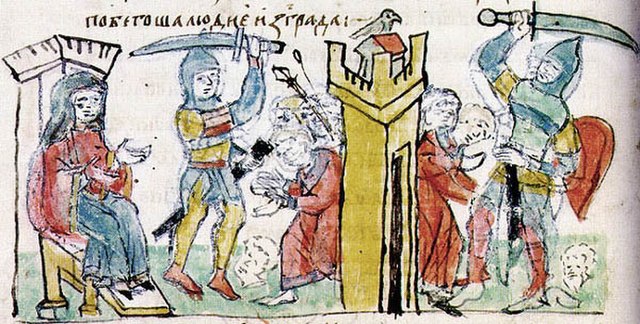
Radziwiłł Chronicle. Olga’s revenge to the Drevlians, 15th C. public domain

As part of an ongoing feud with the Drevlians (a nearby tribe), Igor was eventually “captured by them, tied to tree trunks, and torn in two.” This set a chain of cunning and violent revenge from his widow that would cause much more horrific bloodshed.

The Radziwiłł Chronicle is a later copy of the Primary Chronicle, with more added to it, and has a whole heap of illustrations. As a fan of the style of medieval manuscript, this does not disappoint. I like to narrate them. In the series about Olga, she is usually sat pointing at the events, which I may have mimicked from my office chair. But you can’t prove it! Here she is chilling and saying “ah yes, burn them to death”. If you scroll back up she’s saying – no wait, I can’t tell you that bit yet, it’s for later.

Radziwiłł Chronicle. Olga’s revenge to the Drevlians, 15th C. public domain

Her story is one of those where it baffles me that it isn’t more well known. Even from the cold commercial point of view – it would make a brilliant TV series or film. In a talk recently I mentioned truth being stranger than fiction, and this is one where you don’t need to make it up – as you have it here ready to go! Chronicled!

Perceiving a weakened widow, the Drevlians offered to marry to her to their own prince, Prince Mal. She replied enthusiastically, of course she would, she can’t just be floating around unmarried after all and she was now a free lady! She specified that they must come via boat, and would be carried by her people as an act on honour. How lovely.

St. Olga of Kyiv. Drawing for mosaic by Nicholas Roerich, 1915

When they arrived, they were indeed all lifted up, which must have been a nice treat. However they were then tipped into a pre-dug hole and buried alive. Oops.

Her justification was that they didn’t send particularly high ranking or “cool enough” men, so they should do that and then she will totally comply. Totally. Upon arrival she had them led into a bathhouse for a nice scrub, which was then locked and set on fire. What’s the old saying – fool me once, shame on you, fool me twice….won’t get fooled again?

Still, they agreed to her third demand, which was a mighty feast where she could weep over the tomb of her husband, and finally accept that she had to remarry. Psyche! After they were all drunk on mead, her people killed around five thousand of theirs.

You’d think after this, that all pretence would be expired. But you’re already admiring this BEAUTIFUL collage I just made, and thinking that perhaps that cannot be the case. An attack on Iskorosten was declared by her young son, Sviatoslav, who feebly threw a spear (bless him!) towards the Drevlian forces on her command; this siege lasted a year.

After the year, she said, “Ok, here’s the deal. You just need to pay us tribute. All we want is three pigeons and three sparrows from each household, and that’ll be fine.” Presumably forgetting not to trust this lady at all, they complied. Seems reasonable enough!

“Fly my Pretties” by Annie Norman, 2024

“Annie, why have you collaged a pigeon flying in fire, whilst also carrying some fire?” Just normal reasons. They gave her the birds and off she went, it was all fine. Nobody die- ok fine, lots of people died. Each pigeon and sparrow had a little piece of sulphur and cloth tied to it’s little leg and set free. Yay! Of course they are homing animals, so off they go back to the city to go nest in all the lovely flammable hay and yes the whole place is on fire.

These intros to the Community Miniatures are supposed to be, well, intros. Brief. But we’re getting on a bit more so I’ll fast forward. Olga does a lot of work regarding administration, law making and changing the tribute system, which is fascinating in it’s own right, but has no flaming birds.

So, around 950 CE her travels took her Constantinople, where she caught the eye of the emperor, Constantine VII. Olga was still a highly sought after widow, and after many years of dodging proposals, she was running out of excuses. She had Constantine baptise her under the Christian name Helena, and then said oh no we can’t marry now it’s too weird. (The term used is “spiritual incest”)

You’ll have to look up the rest! She was later on made the Patron Saint of Widows and Converts, the former being obvious and the latter due to her vast work spreading the word of Christianity.

Now how the heck are we going to sum all this up in one mini? Stay tuned….

-Annie
Designing Anne Bonny and Mary Read

I’ve done it again! “What’s that?” you call out in unison. I’ve only gone and overthought something relatively simple and made it a massive task to come back around to pretty much where I was at the start! But, to be honest, what else could you have come to expect from me? Certainly not slap-dash careless mini design! (read the research here if you missed it)

Digitised copy of the printed record of the 1720 trial of Rackham (alias Calico Jack) and of course Bonny and Read.

It’s been a while, but I can finally present you the designs for Anne Bonny and Mary Read. As with many of the figures we design, it starts off like “yeah, easy”, and then before you know it, you’re deep in the comments section of how to load and fire a flintlock pistol and reading trial documents from 1720’s Jamaica.

I think what overwhelmed me was the sheer amount of depictions of these ladies- the majority, of course, not historically accurate, and a fair amount of those somewhat… risque! Female pirates sure have captured people’s imagination and inspiration for quite some time.

The goal is to make these believable for the era, yet still compete with fantasy design for cool miniatures that you’d use in fantasy settings in addition to historical. This was similar to the brief for fellow pirate Jeanne de Clisson. Hopefully, we shall achieve these two as we did Jeanne.

Starting with Anne Bonny

As the two women were of the same era as well as crew-mates, it could have been easy to put them in the same gear. However, I have decided to use this as an opportunity to show off two styles of pirates – the working on the deck and the fancy “out on the town” look. I won’t even tell you off if you wish to swap their names around either (gasp).

USUAL DISCLAIMER: These sketches exist only to inform the sculptor what goes where, I’m not a professional artist and the further details are given via photo references which often can’t be put on the blog for copyright reasons (private collections and the such). The sculptor (Alan Marsh) also tweaks the design as he goes long to make sure it works for single piece casting and 28mm scale.

Figure Design by Annie Norman, 2024

It is said that when she went to land, Anne Bonny would dress up in all the finest styles, a common act of pirates. She could have been in a dress (future mini perhaps?) but I’ve gone for men’s clothing as it suits her story better. Also, she may well have been more comfortable in men’s clothing after all this time, and it could help protect her. And, well, this gear is cool. She has very similar clothing to our Julie d’Aubigny figure, being of a very close period and high society. The references for the coat and trousers are the same, as well as the buckle shoes. And I think it would be very daring of Anne to wear the red-heeled Louis fashion while being a criminal.

Operating in more of a lawless environment, she’s going to have her jacket OPEN (how many times can we gasp during this?), showing off her pirate shirt and… maybe a scarf? I pondered a scarf after scribbling, what do you think? Around her waist is a tied sash, with a belt over (it’s handy to tuck things between the two, guns and such) with the scabbard.

She can be painted historically with long white socks or all sorts of stripes, making her very versatile. I feel the shirt should be more fancy (or have the scarf), so it’s not the same as the standard sailor’s shirt. You can see the ruffled sleeves poking out of the coat.

The tricorne was very fashionable in the 18th century and, of course, another popular pirate icon, so she’s wearing one of those, probably with a nice gold trim! She’s off to shore to have a good, absolutely law-abiding* time, so she has to look her fanciest.

*ha!

“Two women, prisoners at the bar, were then on board the said sloop, and wore men’s jackets and long trousers, and handkerchiefs tied about their heads, and that each of them had a machete and pistol in their hands… the reason of her knowing and believing them to be women then was by the largeness of their breasts.” – An account of Dorothy Spenlow’s testimony during the trial.

What is Mary wearing on deck?

Sailor gear of course! Accustomed to being at sea from her early days in The Royal Navy, I decided she should be in the same outfit as the chaps. It was said the pair dressed as men, but outside of that is pretty much speculation. I’ve come to the conclusion that they weren’t in disguise, especially on deck, but wearing comfortable sailor clothing because – sea is pretty treacherous!

Because she can’t rely on fancy fashion for a cool model, I got really stuck on Mary. I decided to show you my first attempt, bravely. It was a great pose but wouldn’t translate to sculpt very well, so I went with something a bit more classic. A miniature’s silhouette is important, and I feel this works much better. If you do think the first one looks better then shhh don’t tell me.

Figure Design by Annie Norman, 2024

I’m a sucker for big curly hair, and in this case, it can help set them apart from the male figures with shorter cuts. The sea air would give them fluffy locks- I can’t quite see them in the cabin with their ghds somehow. With Mary I’ve decided she is going to go for a “half up half down” as she’s tied it up out her face, with the help of the handkerchief, and kept the lower bit down to protect her neck from the sun.

The shoes are drawn the same as Anne’s, but that was from habit; they’re going to be the more simplified sailors buckle shoes, though at 28mm, they won’t look much different, just softer leather and less of a heel. She’s gonna have a machete with no scabbard and no holster for the pistol, as she just tucks them between her belt and sash – much less faffing for a busy pirate.

What’s next?

Next up, this very evening is…… Olga of Kiev! Whether the blog post goes up tonight is another thing, but it’s totally getting started. We’re also very overdue the relaunch and slight switcharoo, so again thanks for all the patience. It’s just been a heck of a year for me running from task to task!

I also need to send this to the sculptor Alan, with all the photo references and additional notes that I have gathered – after a nice cup of tea though.

Thanks all

Annie.

Jeanne d’Arc Spinoff!

Our first Community Miniatures Project spinoff!

From the start, I’ve said that a side effect of this project could be that it gets my cogs whirring for more minis based on one we’ve made for this – be it another mini, a whole range, some chums, or even just a style or era. It’s another reason that nominating people to be chosen is so important – even if they don’t “win”, I’m now aware of them, and they might creep into my subconscious enough that I decide to make them outside of the project anyway, as a standard release.


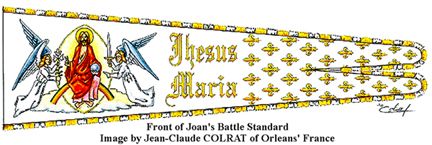
Well I got so into researching Jeanne d’Arc ,that when it came to designing her pennon, I decided to commit to making a battle standard for horseback version as well and then – time to make the mini!

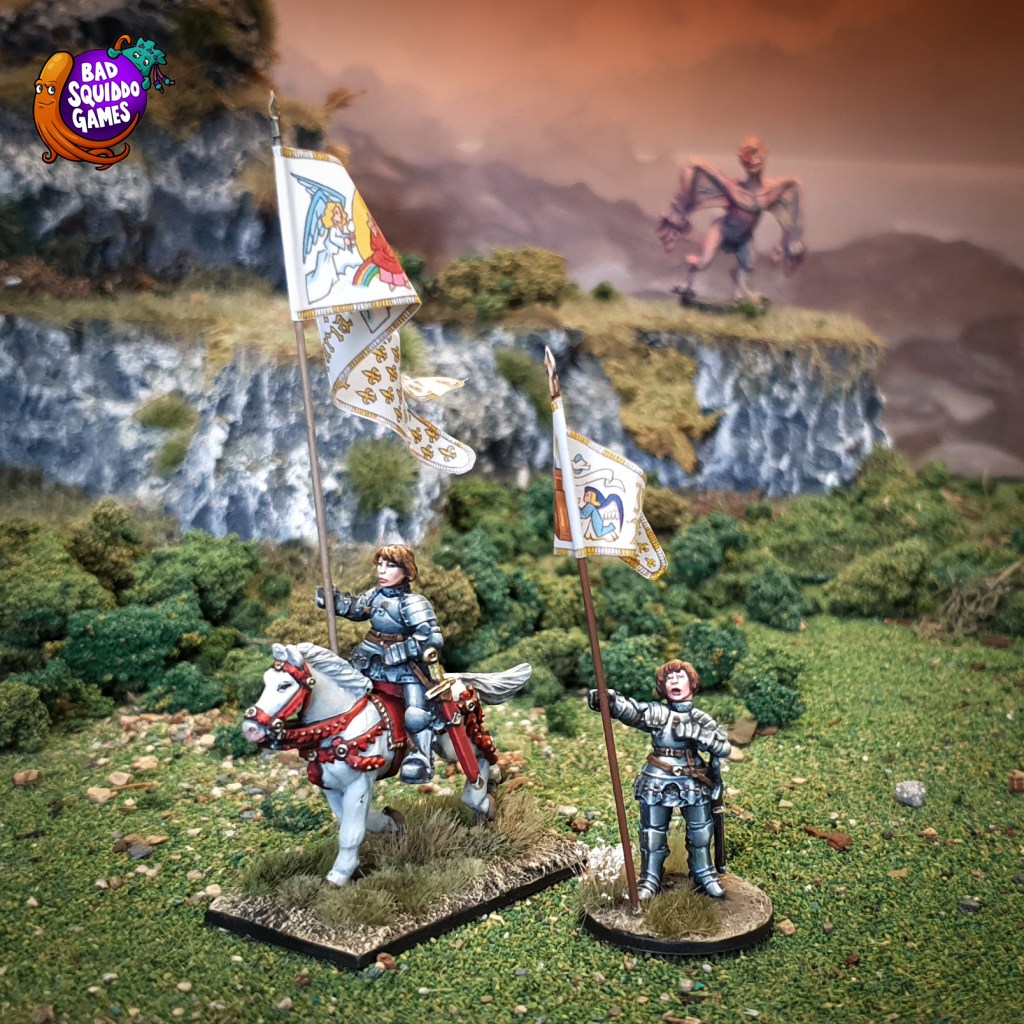
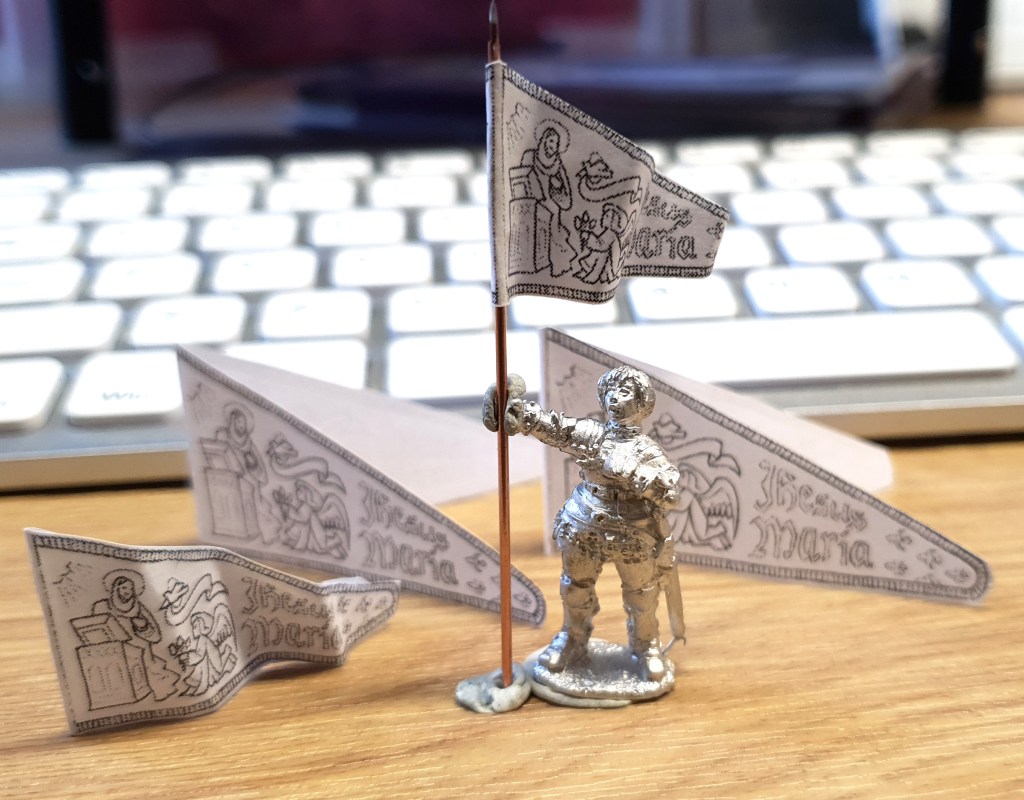
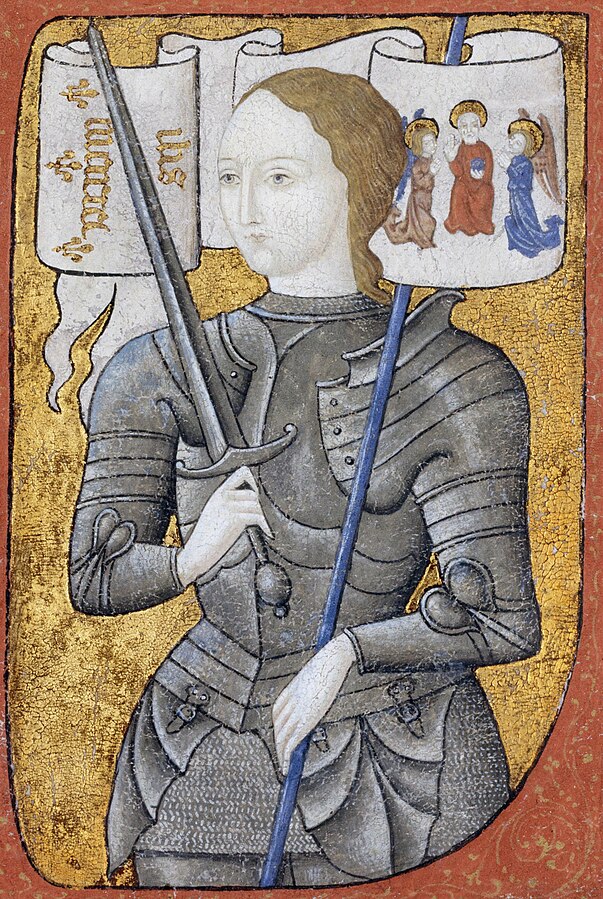
Jeanne d’Arc by Bad Squiddo Games. Sculpted by Alan Marsh, painted by John Morris, banner art by Martin Whitmore and photo backdrop by Jon Hodgson.

Isn’t it stunning? The banner pole was said to be 18 feet tall, which is HUGE, and I tried it to scale, and it was so tall that I chose to shorten it in our version to look more “right” as, of course, 28mm isn’t a “proper” scale as such. The flags are scaled to each other as they are the same width, and this “looks right”.

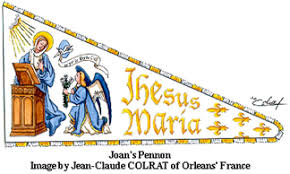
As with the smaller flag, the pennon, you get two of each – in case you mess one up or need a spare for an objective – and instructions. I am SO please how well it’s all turned out!

Something which can cause weakness in mounted minis with poles is the one tiny join to the hand – but we solved this….with…. HISTORY! She has a special saddle called a “selle de bannière” or the “banner saddle”, which has a holster to pop it in to help carry the weight of it all. I can’t imagine riding a horse and carrying that thing, even with a support, which adds even more to how impressive Jeanne was. We have of course given 28mm Jeanne one of these saddles which helps her carry it, and also gives us another contact point – hooray! Thank you, history!

The Mounted Jeanne d’Arc is available now by herself or with the foot version if you haven’t got that yet – both here.

The famous “Jeanne d’Arc confronts Turkey Man” scene from history.

Where are the next three minis?

They’ve been delayed by EVERYTHING going on at once, but I have managed to clear some backlog of far more boring tasks so it’s now #1 priority. I underestimated how much time and energy that Salute and UK Games Expo – our two major shows in April and June – would take. Me underestimating time and energy for tasks is always a given though, I should know this by now (if I wasn’t busy underestimating)

I’m aiming to have the research and sketches all up and in the hands of the sculptor by the end of next week, hopefully sooner (but there’s always curveballs)

Thanks for sticking around, we haven’t done the full relaunch yet either, so there’s that to come too!

Check out who we have available so far here.

-Annie

Making Jeanne d’Arc’s Pennon
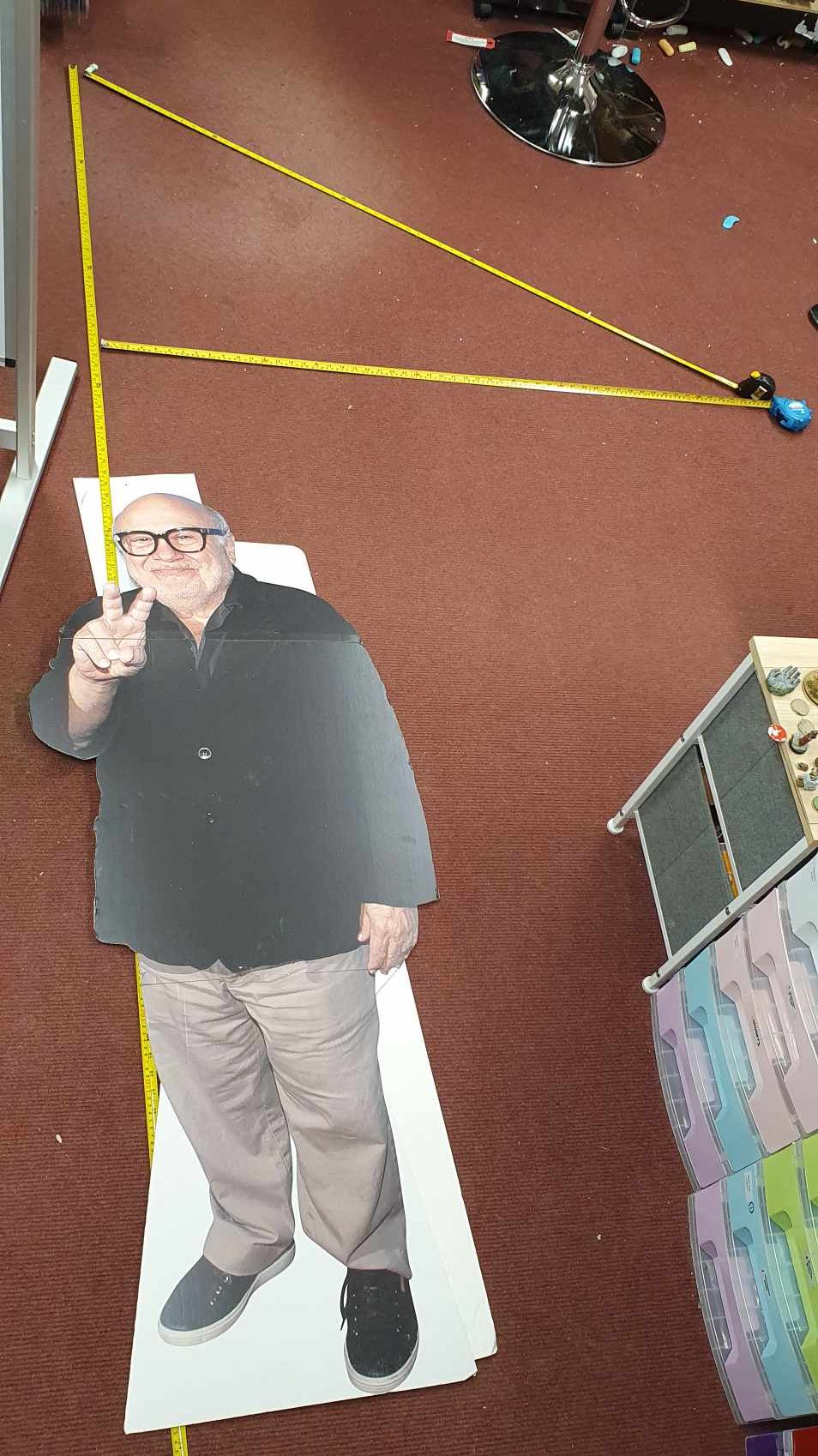
This is one of the tasks as I was dreading as I knew it would be fiddly, but I actually gained great satisfaction from it! I had the dimensions of the pennon and my mock up with the Danny Devito, but it’s not something you can really math. This is because wargaming figures aren’t true scale, so sometimes you need to make things a bit bigger or smaller to help the overall effect.

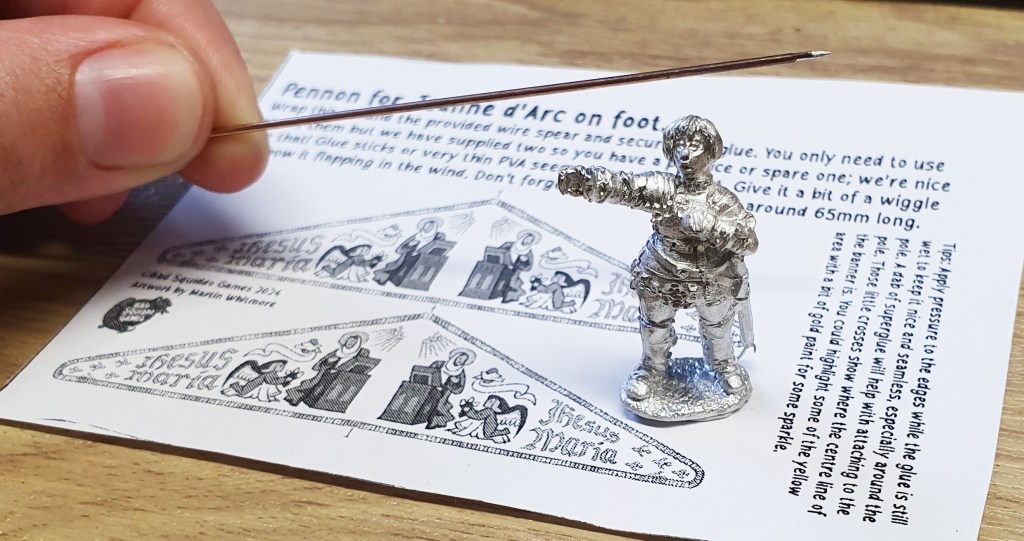
I had a starting point, and then printed off a whole bunch of banners in very similar sizes, playing around til I had what I felt to be right. I then consulted with some chums (Thanks Louis, Jon and John!) and went a fraction smaller. This is both “close enough” to the documented reality and “cool enough” to show off on the battlefield I mean tabletop. Also, I had to figure out how long to cut the spear, as the one provided is very long (There are smaller ones we can use but they’re much thinner, like a fine sewing needle!). The spear is 100mm long and I decided that around 65mm from tip to tip works well, though you can go a bit longer or shorter if you wish.

The pennon will be full colour, we only have a black and white printer at the office so that’s what all my tests are in.

To clip the wires I recommend stronger clippers than usual, not the standard hobby clippers. Personally, I use the Xuron 2193 Wire Shear Cutters. There is no affiliation or anything, just the ones that work for me! If you haven’t got suitable clippers yet I definitely recommend picking up something like these, as they come in handy for all the wire spears you’ll ever encounter! They cut so easy too! And aren’t a huge expense. Much better than thinking “ah my usual clippers will work” and then having to replace those, AND buy strong wire clippers. Ahem. Like some, folk, that aren’t erm, me.

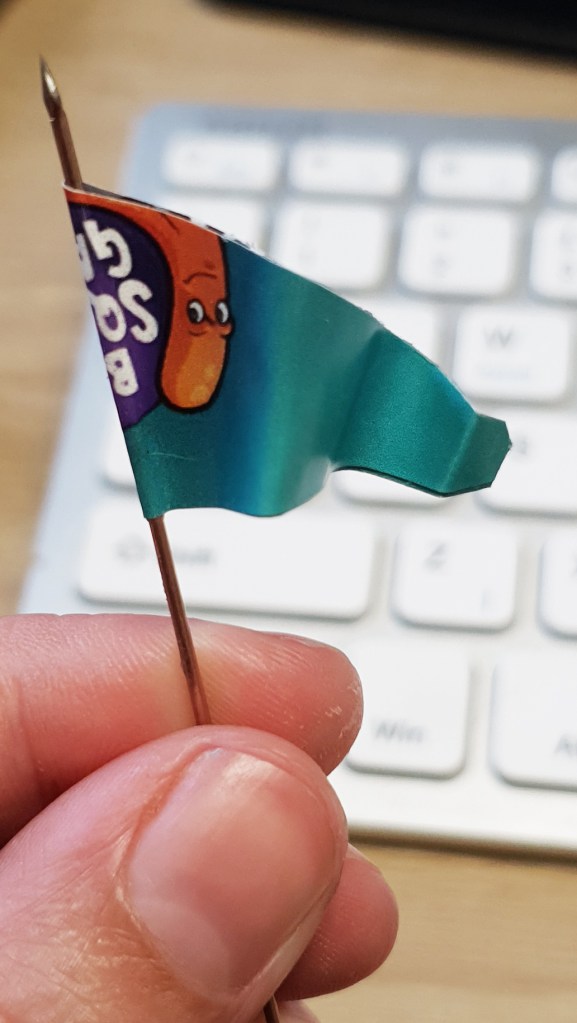
Once the size was decided on, the next query was the paper type, and thickness. I was tempted to go with matt as the real banner would be fabric, but then the print wouldn’t be as optimised as say, silk. Silk is always my favourite! I cut out the size of the flag using one of my packaging inserts, which are 150gsm silk. I didn’t glue it perfectly as I was just messing around, but it worked pretty well. It has a nice quality feel and holds the “wiggle” shape well. It needed to be slightly thinner, so I finally have ordered in 130gsm.

I use a variety of print companies, this time I went for some next day online company, so that I can check it all out tomorrow and start getting cracking on with these.

The final task was filling in the rest of the sheet that the pennon comes on. Seen as I am so.. as we say in the UK “cack-handed”, I decided that everybody would get TWO copies of the pennon – JUST IN CASE.

Not that it’s any more difficult than other banners, but I imagine it would be a right bummer to make a mistake the first time around, like getting the glue stuck wrong or dropping it in your cup of tea! It doesn’t cost us any more to do this, so why not? It means you get have to a “practice go”.

It does mean that there is less space for instructions but hey, who needs those? (me- I do!) I crammed them in! Mostly top tips! So here is a sample of everything you get (PLUS the Collectable Card if you’re in the first 100). And all for just £5. The Community Minis are price locked at £5 for the first hundred and may increase after that, so now is totally a good time to snag your Jeanne!

Metal photographs so bad! This is a rough early test cast but she does the job for my scaling!

Now I’ve ordered these, it’ll be exciting to see tomorrow how they have came out! I’ll do a test with one of my plain spears, and then brave adding the flag to the expertly painted John Morris copy that I have….EEEEEP.

I’ve been staring at flags and spears all day to the point they don’t look real any more, so it’s time to have a stretch and tidy the office I think!

Cheers All

Annie

Designing Audrey Hepburn

Audrey Hepburn was a winner in the polls that I did not expect – but a strong winner at that! It’s a brilliant chance to inform more people about this lady’s achievements, far beyond the silver screen.

Early Years

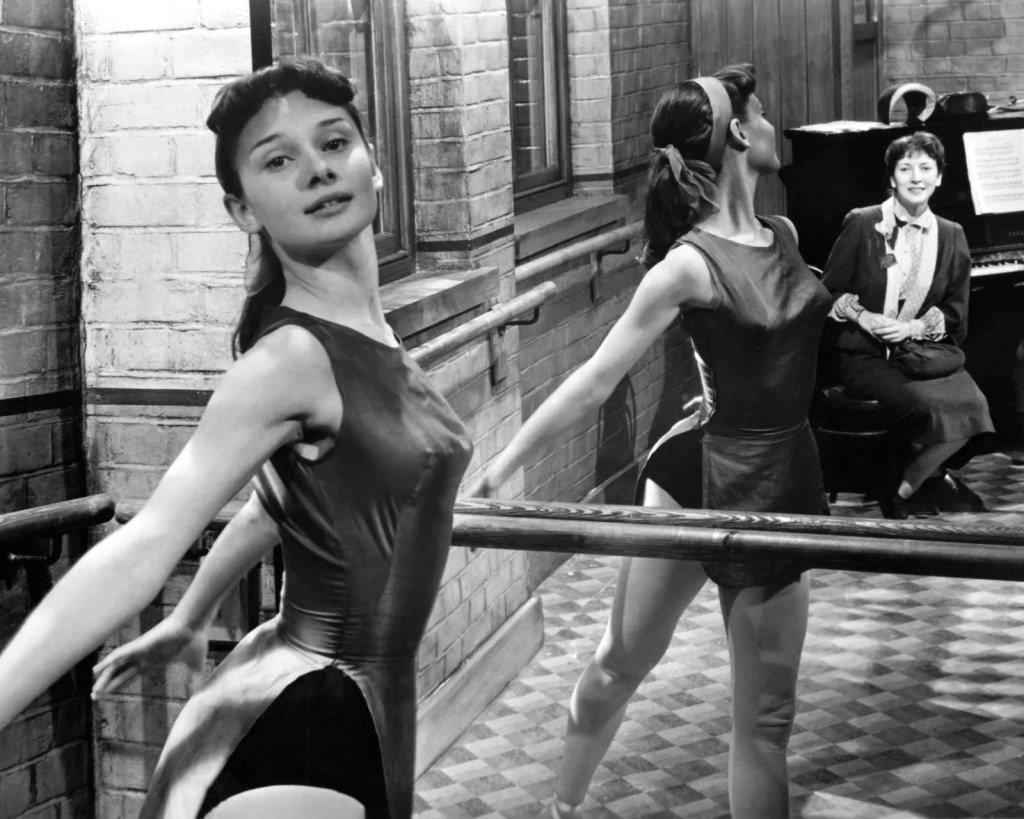
Did you know that in WW2, Audrey aided the Dutch Resistance? Only a girl of 11 when the Germans invaded the Netherlands, she saw first-hand some of the atrocities and did what she could to help fight them. Dancing was her passion, and she would dance at “black evenings”, secret underground fundraisers where the windows were blacked out and audience silence was required. There is something rather poetic about dancing for peace.

“Mum was more than a steel-butterfly; she was a battle-hardened badass.”

– Luca Dotti, Hepburn’s son

In addition, she got involved in more of the resistance activities such as carrying messages and supplies around the underground network and to allied pilots who had been shot down. Most wargamers will be familiar with the Battle of Arnhem, did you know a young Audrey Hepburn was there? She rescued and brought home an English paratrooper, a crime with severe consequences if caught – which, luckily, they were not.

Much like the S.O.E, Audrey’s bonus power with the resistance was her natural camouflage of being a girl. In the early days of the French Resistance (less so later in the war), the women were overlooked as any sort of threat, which meant they could operate in plain sight. Noor Inayat Khan, for example, was caught right in the act of sending a message back to the UK by an SS Officer and winged it by saying she was just trying to listen to some jazz. Small Audrey could also be seen as neither threatening nor suspicious as “just a kid” mucking about, and this saved her life on many occasions.

Later Years

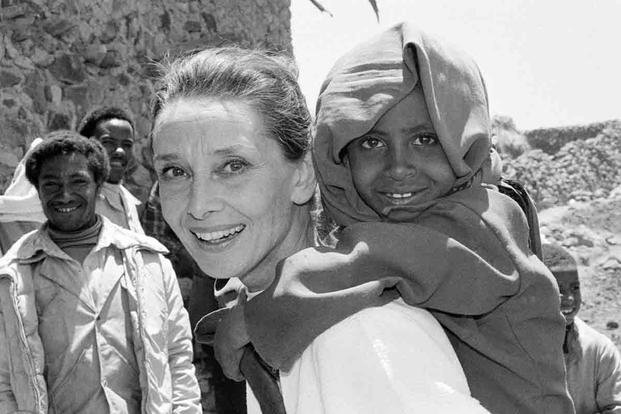
We all know that Audrey Hepburn became a major international movie star, a massive achievement in its own right. Still, I wanted to make sure more people were aware of what she did afterwards, when she retired from the screen relatively early to pursue humanitarian work. She worked with UNICEF worldwide in over 20 countries to bring attention to the various plights, earning a series of awards for her relentless efforts.

“The ‘Third World’ is a term I don’t like very much, because we’re all one world. I want people to know that the largest part of humanity is suffering.”

Audrey Hepburn, 1988

Which era of Audrey do we do?

So, which version of Audrey Hepburn becomes a 28mm Community Miniature? It’s such a difficult question! Having discussed this with the community over on Baggy’s Cave, we agreed on film star Audrey.

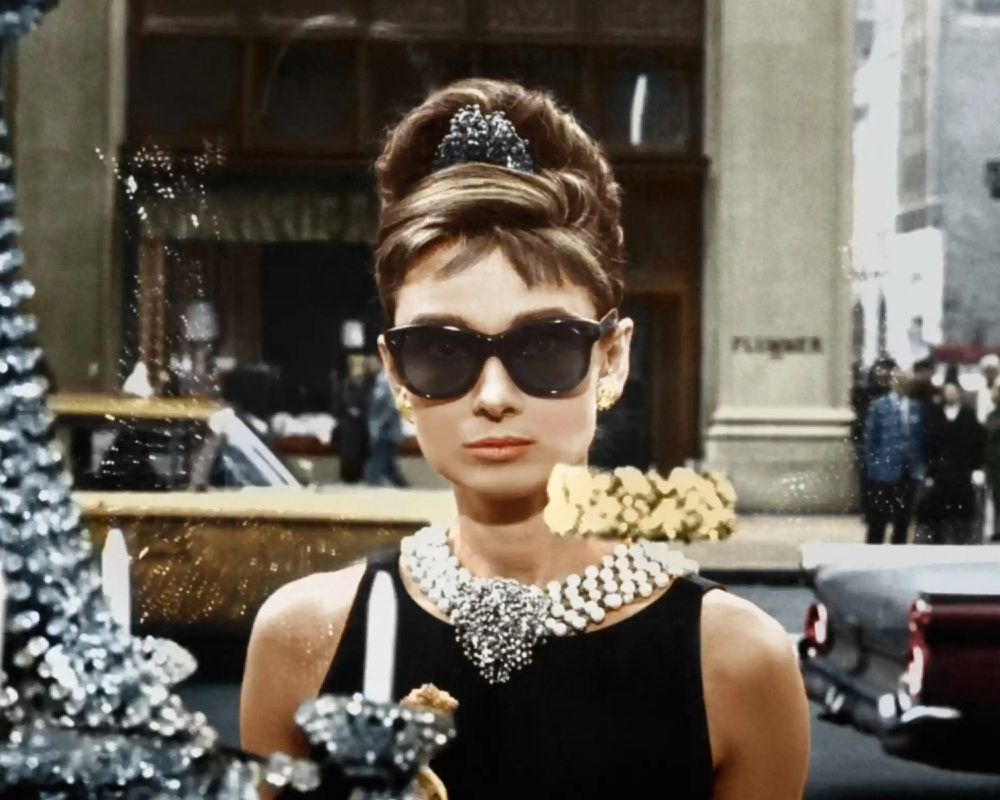
One of the Community Miniatures Project goals is for the minis to be instantly recognisable, and one of her most famous roles was in Breakfast at Tiffany’s. Whilst this doesn’t show anything from the above writing, I feel it will be a much more popular miniature than other versions, and it sets off the talking point of “Did you know….”

Sometimes in a quest to show women’s achievements it can be easy to fall into the trap of brushing off the feminine; this is counterintuitive. Audrey looks stunning here, and it’s not a bad thing or anything to be ashamed of or avoid. She survived through great risks and got to become that Hollywood star through her own determination and resiliance.

I haven’t sketched anything for the sculptor for this one as it’s pretty much this iconic image, with cat of course! No cigarette holder as it would be impossible, but I reckon you could convert one if you wanted with a drill and a bit of paperclip. We’re adding the sunglasses though to make her even more recognisable.

This will make a nice contrast to some of the other miniatures, as you can fight in other ways than with a sword or gun – in Audrey’s case, some of it it was dancing.

-Words by Annie Norman

(Ps – I maaaay be working on a WW2 Audrey simultaneously as it would make for such a good gaming scenario, having her intercept messages and run around the board undetected. Shhhh.)

Designing Jeanne d’Arc

So here we go! If you missed Part One, check this out first. What do we know, first of all? Well, she wore men’s clothes. She has been depicted in dresses and skirts, but that’s more the symbolism, and we want to go as accurately as we can. I also wish to make figures that the historical person would approve of if they could see it somehow; come on Bill and Ted – lend me that time machine! She DIED because of her insistence on men’s clothes, so she’s getting them in 28mm! We won’t give her a helmet as we want to see her face, the face that grown men would have seen on the battlefield.

John Everett Millais – Joan of Arc, 1865, Very much in the Pre-Raphaelite style

In the variety of depictions, Jeanne has much in common with Eleanor of Aquitaine. They’re both shown highly stylised and dressed in what was a fashionably romanticised notion of her period at the time. I see this as a positive; you can see how they evolve over time yet keep the same key components, such as the banner and armour, in Jeanne’s case. It’s not historically accurate, but it is an insight into history in its own way.

I know some folk will want to see her hacking and slashing her way up a rampart, but this also goes against Jeanne’s position. I, too, wish to see more hack-and-slash medieval ladies, but you have to vote for them! We do have Jeanne de Clisson currently, but more would be a dream. Jean Hatchett very closely made it last time, perhaps on the next voting rounds? As I mentioned in the Eleanor of Aquitaine post, it’s good to keep them as much “themselves” as possible, instead of putting them into a different role.

To the Armouries!

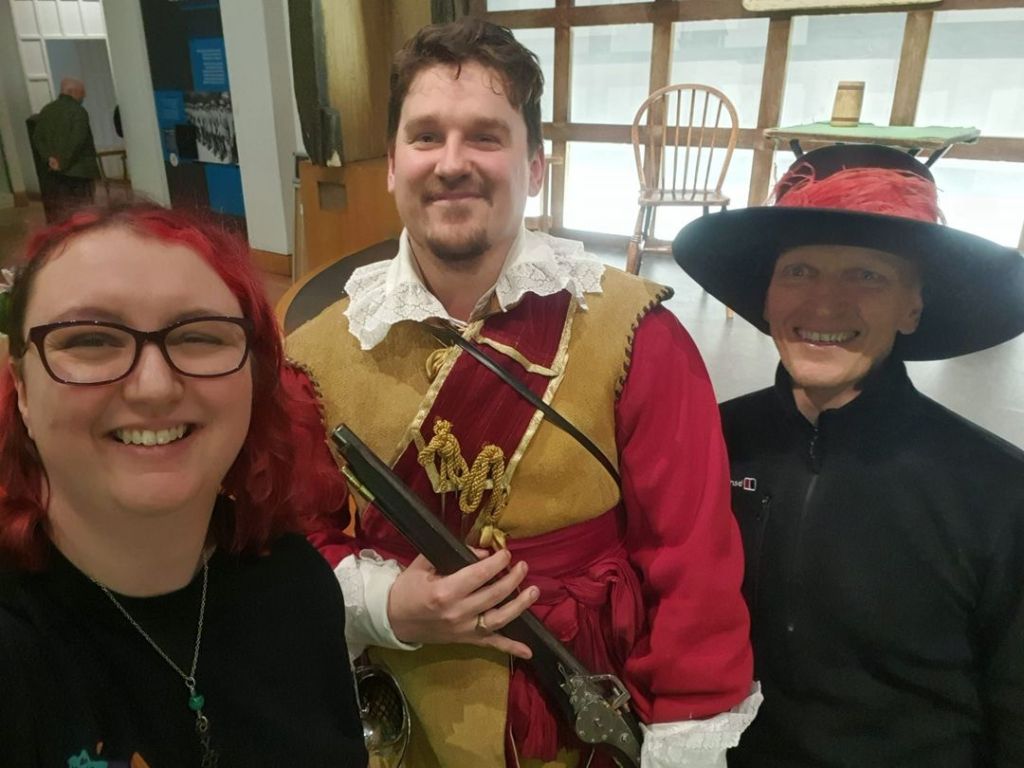
After giving myself a headache looking at all sorts of armour, I decided to go to The Royal Armouries in Leeds for some hands-on research. Sculptor Alan Marsh came along!

L-R Me (Annie), Richard of ECW knowledge, and Alan: not his usual hat.

It was a superb chance to catch up and nerd out with many history chats over coffee and a delicious roulade. For a second time, I was impressed by how many books about women in history the gift shop has, which is even more than last time I was there. Of course, I had to buy some…

It’s brilliant to discuss upcoming figure design while in front of the actual pieces and, of course, feel the weight of different weapons. This all helps with the sculpting process to bring you these awesome-cool minis.

The Banner

Essential in Jeanne’s “kit” is the banner. She had several; important ones for us are the battle standard and the pennon. The battle standard was enormous and too unwieldy on foot, requiring a special saddle to prop it in. If we make a mounted version (I really want to, please buy loads of this to convince me!) we will use that for sure.

The pennon is the foot version, carried on a shorter pole and what she would have had to be mobile without her horse. With the mega battle standard, she wouldn’t be able to walk about.

When considering the pose, I figured that even though this is smaller, she would probably not be strong enough to hold it in the air one-handed, so it will be resting on the ground.

I found the measurements of both flags, so first I lay out the size of the pennon and needed something to help scale, and who better than Danny Devito?

There’s always a debate between cast banner and wire spear with transfer/paper. I have mulled this over for A LONG TIME. Cost is a significant factor, with these minis being £5 each, a big wavy bit of metal adds to the cost considerably. They can also become really clunky. I really want people to have their own unique Jeanne banner, and not a generic 15th century knight, so considered the possibility of getting a transfer made, but this is hard to apply along folds and creases of something sculpted.

Then, I mucked about with a wire spear and the paper we use for leaflets which found it to be a perfect thickness. I never did understand applying transfers to paper, when you could just have the paper printed in the first place. This would be a better quality than standard printer paper as well. So it’s now escalated to pricing up what the cost of our own designed pennon AND battle standard would be, as we might as well do both simultaneously, right! That mounted figure is happening whether I like it or not, isn’t it… (ha I protest too much for sure).

“I love my banner best – oh, forty times more than the sword! Sometimes I carried it myself when I charged the enemy, to avoid killing any one.” – Jeanne during her Trial.

Armour

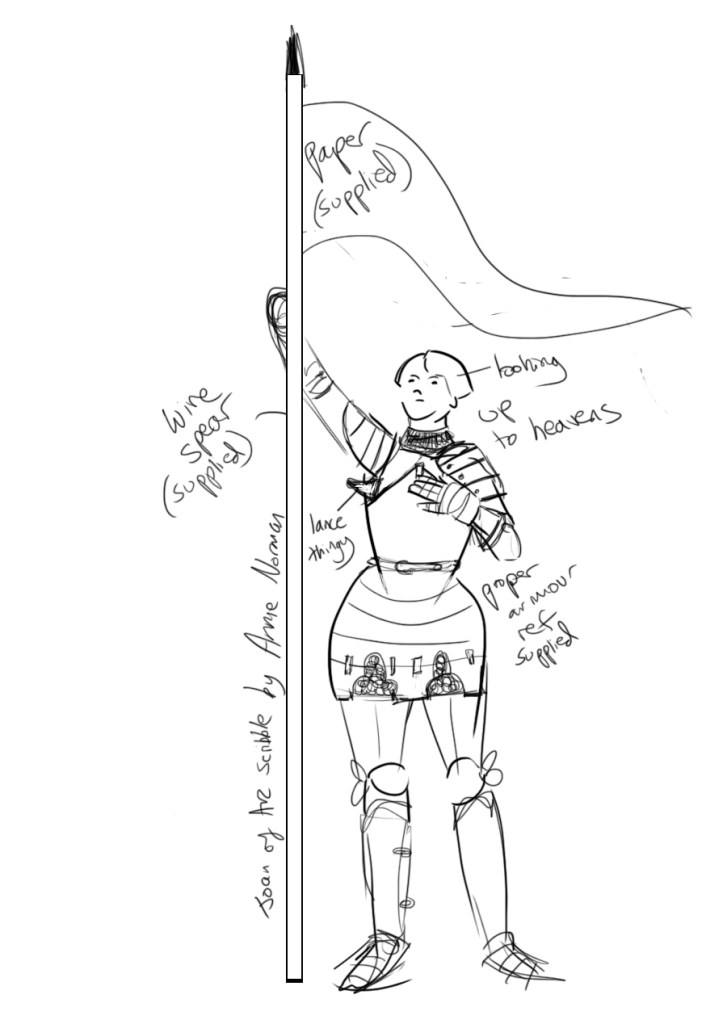
Figure Design by Annie Norman, 2023

Several contemporary references to Jeanne being in “White Harness” armour exist. The white part means that it wasn’t embellished (Sorry Millais) and the harness part is that it is in many separate pieces. Jeanne was first given an “all in one” armour, then used some found Burgundian armour, and then was eventually commissioned this lovely piece by Charles VII. So that’s what I want to put her in.

It’s important to me that the pose is very much lifting the eyes upwards; Jeanne is holding the banner as high as she can so everyone can see, and she’s looking to the heavens for reassurance. These are all little signs that it is Jeanne d’Arc.

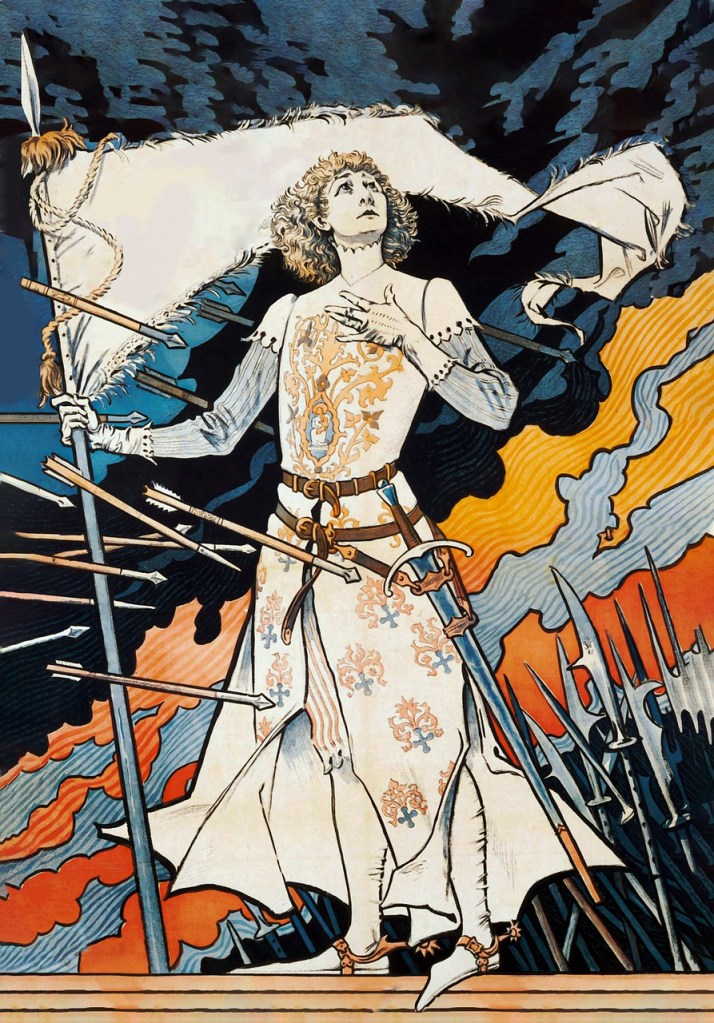
The hand-on-chest pose is used in several of the paintings and statues, and I appreciate the gentleness of it. However, in these, she is often shown bare-handed, I hope the gauntlets still have the same effect!

Eugène Samuel Grasset version of Jeanne

Something missing from my scribble is… The Holy Sword! That will be hanging from the scabbard, sheathed. Jeanne’s sword was the “Sword of St. Catherine”. A companion of Joan’s on the way to Orleans said, “I wanted to sharpen that old blade, but she said it was not necessary, as she should never kill anybody, and should carry it only as a symbol of authority.”

For the hair, we’re going for a shaggy bob, again to stand out more than a full “short back and sides”. This is one of the artistic decisions to make minis less literal sometimes, but not too far off reality – for example long flowing locks would be far off! A grown-out, super short hairdo is more justifiable.

I’m cutting this short as I feel like I’ve lived non-stop Jeanne for the last month and there is SO MUCH more I could write, but we’re nearing the end of the calendar year and I am sleepy, with more blog entries to complete!

The goal is to have these last two sculpted by the end of the week (ish) and then we can get voting on the next two between Christmas and New Year. Hooray!

What did Jeanne d’Arc actually do?

Here we go. Strangely, this is the figure I am most nervous about designing so far. Joan of Arc, or Jeanne d’Arc is known and beloved by many, and perhaps THE most famous military woman in history, if not a solid top-five contender! She’d be a winning answer in Family Fortunes.

Jeanne D’Arc being excellent

The nerves come from this, that people have their own idea of who Jeanne was, what she did, and what she looked like. She’s a household name and has been portrayed in so many movies (of course, most memorably in Bill and Ted’s Excellent Adventure), some more faithful to historical records than others.

Jeanne d’Arc was born in 1412 CE, during the Hundred Years War, a long and bloody conflict between England and France, which she would be destined to shape. From a young age, she began hearing what she believed to be the voice of God, though there are attempts at modern diagnosis to explain this on a secular level. We will never know, as per the words of Ridley Scott “Were you there mate?”

This led her on an incredibly daring mission to ensure that Charles VII (currently the dauphin) was to be crowned King, and then his army could save France. The fact that a young girl could walk up to somebody so high ranking is wild enough, but the fact they [eventually] paid attention is even more fantastic. “Scuse me, Sirs, you’re doing war wrong”.

Jeanne led the French Army through highs and lows in the pushback against the English, becoming a mighty hype for morale, waving her banner and yelling for them to push on. An army believing they have God on their side is exceedingly powerful. While it was unlikely she would have fought intentionally, due to her age, size, and lack of combat training, Jeanne’s presence and encouragement were where her power really lay. In wargames, we have rules such as “Inspiring Presence” for banner bearers, and it really was just that!

Jeanne as portrayed by Milla Jovovich in “The Messenger”, 1999

After a defeat at Margny, she was captured, after pretty much being abandoned by the King she helped create and put on trial by a mixed jury of French, English, and their French allies – the Burgundians.

The trial was as you can imagine – incredibly unfair. However, Jeanne was brilliant (the record of the trial is actually online) and managed to make it through the thorough questioning. What I find bizarre, about the entire odd tale, is they effectively “got her” in the end for her trousers. She insisted on wearing men’s clothes to show she was a soldier, the same as others, and under the direction of God. Crossdressing was seen as blasphemous so she was sentenced to death. Refusing to refute her Mission from God, Jeanne d’Arc was burned to death before a public audience on May 30, 1431, aged just 19.

I normally keep these summaries reasonably brief, to encourage people to read more, but there’s a bit more this time. Sometimes a story or figure can become so well-known that you actually forget the details. So there’s a refresher! There is course far, far more to the story, but that’s the jist!

Designing Jeanne d’Arc

You know what? I’m putting this into the next entry, as this is fairly long, and I have a BIT more research to do. Keep them hungry, as they say!

-Annie.

Designing Ada Lovelace

If you haven’t already read about my visit to see actual Ada Lovelace in person, then you should totally go and read that first.

As is now tradition with this project, I ended up way off track, spending a whole evening figuring out what the Analytical Engine WAS, and the purpose of punch cards. Some of you older folks (older, not old!) have helped to inform me on those, as it was a lost tech by my time!

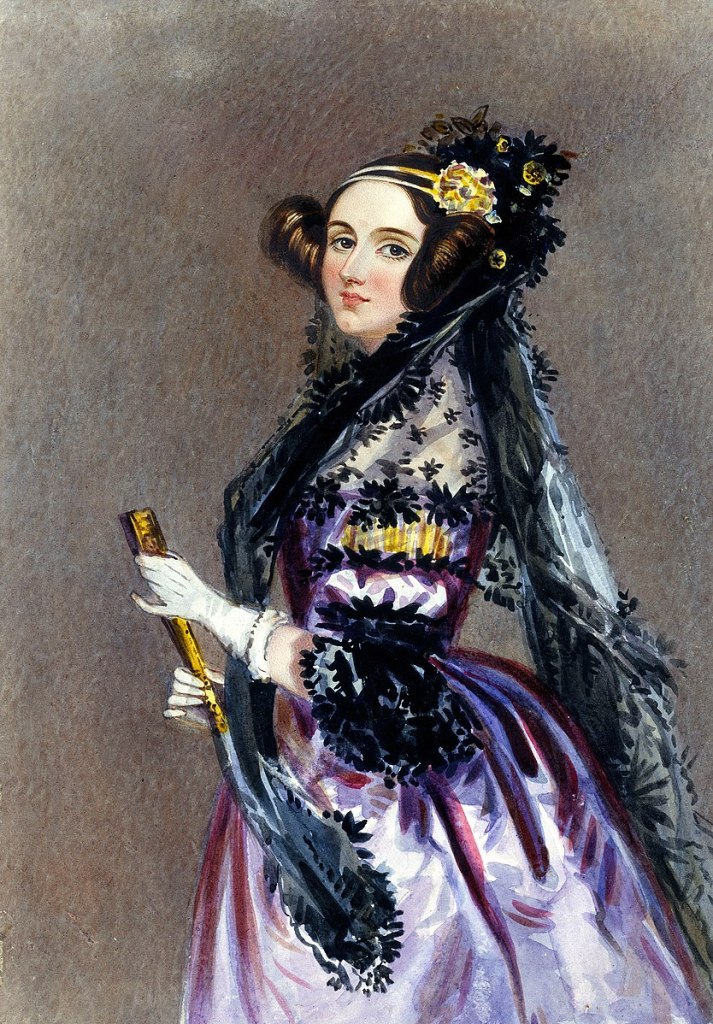
Ada Lovelace by Alfred Edward Chalon circa 1840

Ada Lovelace (born Augusta Ada King 1815 and died 1852) is a very well-known mathematician, recognised as being the very first computer programmer. She worked with Charles Babbage on his Analytical Engine, which was, in basic terms, a massive calculator slash early computer. It was theoretical, so they did not build it, but Ada’s annotations and calculations became the foundation for much of the technology we use today. We can blame her for those danged algorithms, she published the first one in 1840.

The daughter of “mad, bad and dangerous to know” Lord Byron, she was kept away from her father and the arts by her concerned mother Anne Isabella Milbanke, Lady Byron. Fearing the arts would corrupt her into the debauchery of her lineage, Ada was given a very scientific and mathematical upbringing by some of the best tutors available.

Designing the Figure

Ada Lovelace, sculpted by Etienne and Mary Millner. Located on the 7th floor of Millbank Quarter (formerly Ergon House), London.

From the start, I knew I wanted her to be wearing very fancy hair and dress as she was often portrayed wearing, most famously in the painting by Afred Edward Chalon. However, I don’t want her to be static.

Figuring out how to show someone “doing maths” can be quite the head-scratcher – which incidentally was a pose I pondered! But she was far more than any standard mathematician, and I wanted her to be more unique.

The “ah ha!” moment came with the punch cards from the Analytical Engine. Upon researching statues of Ada, I came to the conclusion that others had had the same idea and the same struggles! A fantastic piece by Etienne and Mary Millner, I can almost hear them going “argh just hang the punch cards up behind!”. I feel the struggle.

So let’s get to the Annie sketch. I feel she will work holding the cards up, perhaps quizzically, studying them. Regarding casting, they can almost cascade down her arm, something I am confident that the sculptor will figure out. They would need to be shorter at the very worst, but I think this is unlikely. I’ll get him to indent some holes into them, well – divots, so an ink wash will fill them in for you.

The veil in the painting will be harder to translate to a solid sculpt, as I have noticed from the more enormous public statues they have removed this, and we will too. It works beautifully in paint as it is translucent, but it would be quite a solid block in metal, especially at this scale.

I think this will make a lovely miniature to paint, and people can get really creative with the dress fabric, or if they are daunted, can paint it a solid colour with a wash and have it still look lovely.

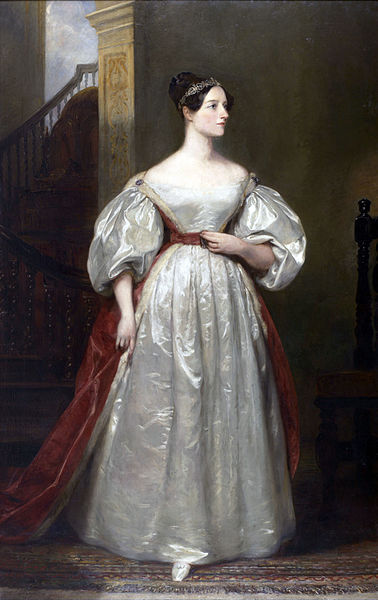
Ada by Margaret Sarah Carpenter circa 1836

Regarding the dress, there is another painting which shows her front on. It is a different dress to the purple, but I intend to converge the design to make something which works well. Splay the bottom of the sleeves and add those delicate gloves.

That’s all there is really for the design of Ada Lovelace. Anything else to note? Oh, the weird hand in the sketch! I am very tired and figured I could wind myself up trying to figure out the hand for the rest of the evening, or just tell the sculptor what I meant, and he’ll do it fantastically! Wahey! That’s the process, folks!

I am very much looking forward to seeing a lady in a massive fancy Victorian dress figuring out complex maths thingies. Yes! Are you?