Yes, you read this correctly! While we have already revealed a design and notes for Mary Fields, it’s not over til the sculpting guy sculpts! If you haven’t read this first, you should! I listened to your feedback on making Mary more dynamic, and I agree. I was also concerned about her heavy mailing sack adding too much to the cost of the mini and limiting her use on the tabletop.
It’s been a while since posting as I was focussing on getting the first 6 in people’s hands, but it’s a weekend, so I’m doing some overtime to get stuck back in while the mojo is strong. I’m much happier with the redesign, which you’ll see soon, but I would love your feedback.
When I was reading about Stagecoach Mary, I got the impression of such a no-nonsense lady who, despite the preconceptions of many, could be absolutely terrifying. She fought off wolves and bandits, on her own, in the snow! She carried masses of weight in short time frames over mountains! I don’t want her to be standing passively.
Here is the before and after.
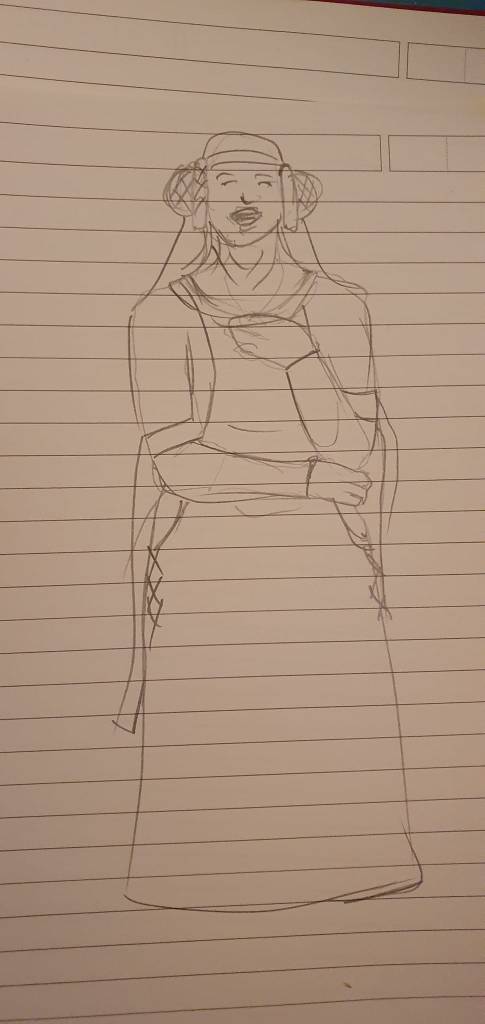
Two rough sketches by Annie Norman to design the miniature. Usual disclaimers that the art is purely to convey what goes where, and any anatomy weirds or fabric weirds or ANY weirds will be corrected by the sculptor!
I decided to keep the cardigan, but I’m not 100% committed to it- again – feedback is immense! I liked it from the photo as something quite feminine she might have wanted to hang onto, but it could be swapped out for one of her winter coats, what do you think?
In this pose, she is striding forward in a bit of a stalky manner. Perhaps she saw or heard something when she was driving the stagecoach or tending to an evening fire, and it made her have a look around. She can’t decide if she’d rather find man or beast.
The skirt has been made shorter to show more of the form underneath for you and the sculptor. It could be hitched up, or it could end up being longer again in the sculpt, but it’s something I’ll probably leave to Alan Marsh, the sculptor, to see what works best. Sometimes, it’s only clear during the actual sculpting stage when you have the 3D model physically there. Underneath, I would assume she has the standard-era boots, possibly with the postal uniform trousers tucked in for extra warmth and modesty. Any extra detail such as a pistol or whiskey on the belt would be down to the sculptor as well; a matter of if they would fit anywhere naturally or to keep it simpler.
This design makes me much happier, what do you think? I’m also much happier with my doodle! It works as a more action pose of the famous picture while keeping her trusty shotgun over the posed rifle.
While you’re musing, I’ll make a start on Ada Lovelace!
Hi friends! Apologies for the late update, I feel I’ve updated everybody everywhere apart from here – the one place I definitely have to. This issue has held up more progress than it should have, because of my funnily wired brain, but we’re back on track now. Also, I decided (well, my brain decided) I couldn’t progress with the next figures til this had been typed out.
What’s the delay? The first wave of minis are supposed to be in people’s hands already, right? WE HAD A SMALL HICCUP. Just a lil one. Kinda. I turned it into a teaching opportunity, of course!
Before I go into those details further, the shorter version is:
They will be coming very shortly, there were delays caused by changing a part of the sculpt of Julie D’Aubigny and finding a suitable company to print and cut the cards, which are both done, yay! HOPEFULLY, most will ship by the end of this month.
What happened?
It was entirely my own oversight! When designing a miniature, there is much more at play than what simply looks good. The miniature must be able to be cast many, many, times without fault; there is a fair bit of engineering that goes into making sure that works.
First, let’s look at the Version One. A stunning miniature, you will agree, and top paint job, John! This angle shows very well how one “one plane” this mini is. You could trace a straight line from the tip of her sword, up her arm, up her face, right up the bridge of her nose, middle of her forehead, and back down the other side.
In terms of casting, this is a doddle. Figures get more difficult the more “planes” there are. Imagine she stuck her left hand out to point at us from the screen, that would complicate matters. Also, she would be alive.
The issue is… what even is this line? A metal mould is made of two parts of rubber or silicone in big round discs. When the mini is being moulded, the sculpt is squished between the two under the golden combo of heat and pressure to make the cavity, which we later fill with metal to create the cast.
The point at which these two discs push against each other in the moulding process is often called the “mould line”. These can vary from extreme to a mere feather, we like to pride ourselves on being the feather variety! Although sometimes they can be more prominent depending on the figure design.
The sum up of all the above is basically that the mould line was going down the middle of the face. But this project will hopefully teach you a bit about the background of how minis are made and the tribulations we may run into on the way!
While our mould lines are barely visible, nobody likes it down the middle of the face. It’s such an important part. I should have spotted this before she went to casting, but stuff happens!
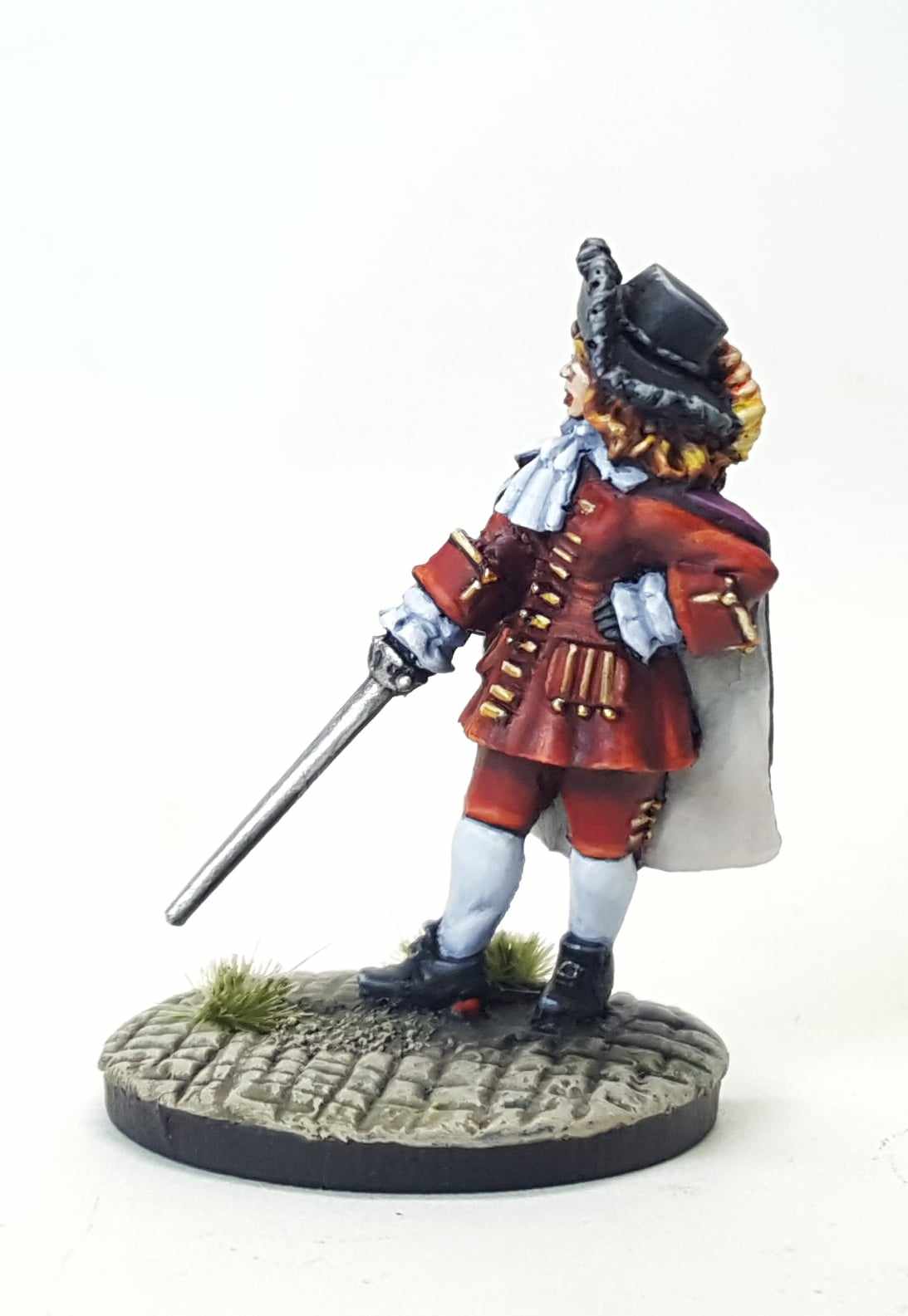
Julie D’Aubigny MK2, sculpted by Alan Marsh
Of course, I waited until she had been painted, and a huge chunk of her had been production cast already before I decided she had to change. Had this been earlier, we would still be on track – doh!
Was she good enough or not in her current state? I couldn’t decide. The line was minimal, but it was on the face, which is a mega pet peeve of mine in my own hobby adventures, and it wasn’t the usual done thing for Bad Squiddo. But I knew I was fighting against time, as this project is so far behind.
I felt absolutely sick when I approached the caster asking for the sculpt back, as I knew there was potentially a big extra cost of resculpting and money lost on the castings (we can get a bit back by throwing her clones into Mount Doom, though) as well as contacting Alan, the sculptor. It was none of their fault, but I was worried they wouldn’t be happy with my choice. BUT I AM A SILLY. I have worked with these people for years, and they’re lovely, DUH! They were ace, phew!
The best bit was that Julie was almost intact. When a sculpt has been moulded, they’re often broken and sometimes pretty much just crushed to dust! I didn’t want to convert a cast. I’d built it up in my head as this major thing. So I was ELATED to see her pretty much as she was before the moulding. Sculptor Alan Marsh is a dream and converted her easily before shipping her back to the casters.
So how did he fix her?
Decapitation! I believe he chopped the head off to turn it more forward-facing, but it looks like it’s been pretty much resculpted, I am sure the framework stayed the same though. So, the head was chopped off at the neck, rotated, and plopped back on. Then, the resculpting of the face and hair and anything else that was knocked off in the process, as well as a general MOT as she had “seen some things”. Alan noticed part of the hilt was missing, which I totally hadn’t spotted, so multiple eyes are good! That was sculpted back on, of course.
Now, if you trace that same line up the sword and arm, it now goes over her shoulder and up the side of her face, where the hair is. A cheeky little hair of a mouldline in her curly hair is fine; you can scuff it off with a blade, and it’s gone, much better than performing facial surgery.
HOORAY!
This has now been master cast, approved BY MEEE, and is now in the production stages. Poor John Morris has to paint her again, exactly the same as last time, please, John!
The Pretty Cards
The Pretty Cards will be ready once MK2 Julie is painted! Also, I need to finish designing them, I hope to update this blog very soon with those drafts. I was using Julie as a bit of an excuse as I could have been designing the rest, but it has been very busy around Bad Squiddo, and the time has just flown by.
New Printers
The other delay was figuring out how these cards would work. I want them A7 with rounded corners. But when you order from printing companies, they charge SO MUCH just for rounded corners, especially on low number runs (just 100 of each design), it was going to be a problem.
I’m on fire with these stock images today.
Investing in my own corner cutter even seemed an option – a heavy-duty one. I browsed through quite a few of those. They didn’t seem too great, though, really, the manual ones. Then it went into thousands of pounds, so I was back at the drawing board. That was until… I found a company! They seem really nice and helpful, and I met them in person and told them all about the project. I won’t name them yet in case it doesn’t work out (hehe, yes, I have made that mistake before), but it seems highly promising, and I’ll be going through some print designs with them next week. So, the delay was really useful in that sense, as I may well have found a new printing company for Bad Squiddo Games as a whole, not just this project. Yay!
Another accidental victory is that I really prefer the stance of the MK2 Julie, what do you think? I think she has more of a stronger “golden angle”. It shows how such a small change can create such a noticeable difference.
So there we go; silence doesn’t mean abandonment. I have just been pulled from project to project lately, and this week have a rotten cold (boo), but many wheels are turning. Hooray!
While I do my best to remain impartial (ha!), I was thrilled when Mary Fields was chosen. She’s not as well known as many, and should be! Also, her photo has a habit of being misused in articles about Harriet Tubman. They were both strong-built women who had escaped slavery and forged paths of determination and no-nonsense, living in the USA around the same time. But their stories are quite different; let’s have a look.
Mary Fields is known for being the first Black woman to work as a mail carrier in the USA. She defied the odds not just because of her race and gender but also her age, as she was SIXTY-FIVE when she began that job.
Born in 1832, Mary lived a full and long life until she passed in 1914, aged around 82. For some perspective to many readers, World War 1 had started then. It can be easy sometimes for these stories to feel like they occurred much longer ago through the old, faded photographs. In fact, the current oldest living person was born in 1907 while Mary was alive, so some of our grandparents or great-grandparents (whereabouts) could have even shared a whiskey with her.
Mary Fields approx 1895
As a recently emancipated Black woman, Mary was not expected for her to be so sweary, drinky, cigar-puffing, fighty or headstrong – qualities which garnered her respect from some and disdain from others. The Civil War had seen an end to slavery, but it would take much longer to change the attitudes of many of her countryfolk (unfortunately, some still aren’t there today).
When Mary landed the mail carrier job – by outskilling the much younger male applicants – she really made her mark on history. While at first sounding like a dull job, as we think of our local posties and while we love ’em, it’s not precisely death-defying, is it? Well, it was back then! Travelling alone across vicious terrain, there was danger of the extreme weather and wild animals such as wolves and the worst monster of all – mankind. Bandits waited in these parts for such a super looting opportunity. Sometimes the stagecoach (“Oh THAT’s why she’s called Stagecoach Mary!”) would be stuck in mud or snow, and she would go on foot. The most important thing to her was getting every single letter and parcel delivered on time. Evri, take note. YOU HAVE CARS.
She worked diligently at this for eight years with whiskey for warmth and her multiple guns and wits for safety. Remember, she was 65 when she began, so she was around 73 at the end of this career. This work would be taxing for any other person at their absolute peak, which shows how strong she was physically as well as mentally. It wasn’t just Amazon impulse buys of cutlery organisers (look, it was one time, and my cutlery takes up way less space now); it was life-saving urgent medication and equipment and food, as well as perhaps old-time cutlery organisers.
Unlike many of these women I research, Mary Fields got to have a nice retirement, phew. I highly recommend reading more about her, as there are so many stories, several quite funny too, but I try to keep these FAIRLY brief, so I can’t put it all in.
Designing Mary Fields: The Miniature
Hooray, we have photos! That always helps! It also means I don’t need to do a huge amount of clothing research, as the gear she has in these photos is what she would have been wearing, so we don’t need to speculate.
Photographs are not flawless, though, as we have learnt so far, they sometimes don’t tell the whole story. She’s pictured in the most famous picture (the one at the start of the article) with a Winchester but was known for being brilliant with a shotgun (second pic, just by this text), so while tempting to copy the photo, let’s change it to a shotgun. She also loved her six-shooter (revolver) tucked beneath her apron, but shall we have it peeking out? I need to move it to her other hip so she can draw it from her right hand.
As always, the crude drawing is just a starting point! And I may be being a bit lazier with getting them looking human now that I know Marty will do a better version after (oh yeah you might have missed it, Martin Whitmore has drawn some INCREDIBLE art for you).
The arm resting the gun on her shoulder frees up one hand and the frontage of the mini, so more detail can be added. I’m unsure about the other hand holding the mail sack, but I think this could translate well through the sculpt when Alan makes it have some real heft; perhaps she is walking forward a bit, dragging it?
She currently doesn’t have a messenger bag on, but perhaps on the back? I like the idea of her feeling very weighed down by the post. I’m conscious of the weight of the mini as I’ve declared these will all be £5, but that’s making me think more about a fixed £5 price for a certain amount of time so that I can raise them later if I need to.
Her jacket to the side a bit to show her holster with the ol’ six shootie in it and a hipflask of her whiskey. Perhaps instead of a whole strap for that, it could be the strap for a messenger bag, with the hipflask attached at a buckle? The bag could be half open as it’s bursting with letters? Lots of perhaps, of course, as this is a COMMUNITY minis project, so I really want to hear your feedback. Also it still doesn’t mean I can please everyone, as I can’t take every suggestion, but they really have steered this so far, and I want them to continue to.
This article totally doesn’t show the hours I’ve spent this afternoon researching Mary and then little things like mail carriers uniforms, mail bags, gun types etc. Where has the day gone! Before I forget, later on, the uniforms are Cadet Gray.
This project has been a blighter for “things I thought wouldn’t take long but it’s 4am and I’m crying in confusion at the difference between necklines”. Slight exaggeration, no tears, and only 2pm. I thought Ching Shih would be an easy one based on the fact there appeared to be a really clear woodcut of her waist upwards that I could use.
As always, the more I dug, the murkier everything got! These two images are featured in maybe 99% of articles, book illustrations and form the basis of many art pieces of her. Neither is Ching Shih! The second one MAY be, but certainly not contemporary or based on fact. It’s a classic case of something being imitated until nobody knows where it originated.
So, damn. That was my “easy start” obliterated!
Neither of these are Ching Shih!
Before I talk about the design process though… who was she? She lived from 1775-1844 which was the Qing Dynasty in China. Her original name was Sek Yeung, all future names translate to mean widow of her husband – Zheng Yi. I have found different spellings of all throughout this which I think are just variants but please inform me if I’ve gone wrong somewhere. I’ll use Ching Shih for the article as that is how she is commonly known here.
Zheng was the commander of the Red Flags – a band of pirates. His fleet was around 300 ships, which Ching Shih inherited after his death. She took over immediately and over a relatively short period of time, through immense leadership, turned this fleet into around 70,000 crew and 2000 ships, said to be the largest ever. And why isn’t she a household name? Right?
This also is not Ching Shi!
She implemented a notorious code of conduct that gave women more protection, though, of course, they were still all pirates, so it would hardly be considered revolutionary today, but it was at the time. With the aim to make her crews behave better, rules with harsh punishments for how prisoners and female crew mates would be treated were introduced. In her earlier years, Ching Shih had been a sex worker, so you could see how her past experience had made her slightly more defensive of the women brought aboard than a standard male captain, having been in similar positions herself.
The fleet was so large and havoc causing that it attracted the attention of the Chinese Navy, who upon failing drastically to catch or destroy the Red Flag Fleet, eventually agreed to a treaty where she was pardoned, retired, and secured a pretty decent chunk of cash to retire and set up a gambling den for a chilled out and comfy retirement.
What the heck might she have looked like then?
I figured it out! Maybe! As always, there’s the balancing act between 100% accuracy and a cool model, and as always, I reckon I nailed it! So the hat to begin, many show her in a Qingdai guanmao aka Mandarin hat, which is a bit too official and solider like, especially for such a renegade. I did ponder the wide-brimmed straw hat which was commonly used at sea but decided, in the end, it might obscure too much of her face and therefore recognisability. Especially when I discovered that fairly elaborate buns are a hairstyle of choice for many boatwomen in a bit more of a formal setting, I figured that would look cool, and be realistic, as being a pirate queen and all, she would want to look a bit fancy. I’ve gone for a few strands down because of the wind and sea.
In her hands are a sack of coins and a dao, Chinese one-handed sabre. I am a fan of the “en guarde!” pose more than just standing there holding a sword. You just caught her looting your treasures and she won’t go down without a fight!
I am uncertain about the scabbard as to which way it would hang so need to figure that out before it’s sculpted, any ideas?
The clothes are quite simple. A silk tunic, which people can paint designs onto if they like, and some wide-legged fishing trousers. Many portray her wearing wudang socks with the trousers tucked in, but sailors seem to have these open trousers, which I guess dry off a lot quicker.
It seems like I didn’t do much research to get to these but it took such a long time, mostly on what NOT to do, so the result from all that is something simple, yet with a lot behind it. Oh yes, the belt! The belt is a solid status symbol, so that will be all jeweled to show she’s a leader. There isn’t any jewelry because again, she’s at sea.
As always my sketches are not as cool as what the sculptor will come up with, but soon you’ll be able have to trained your eyes to autocorrect to what Alan will make in 3D.
This means that all six of the first Community miniatures are now designed and being sculpted, so we can soon make a start on the next three – I am excited as to who you will choose!
Living a long life from 1122 to 1204, Eleanor managed to reign as Queen of both France and England and is known as a fierce forward striking intellect, as well gentle lover of the arts. I have absorbed so much information on her life and influences during my research that it will be hard to keep short! Also apologies if this isn’t written as well as the others, I wrote a huge chunk, time passed, then came back and edited it heavily once I had learnt much more.
As with many women around this period in history, she is often noted for the men she was connected to, especially her husbands and sons, which can make research frustrating for wanting to find out about her in agency as her own person. The books I have found the best for this research as those by Alison Weir and Sara Cockerill.
She was married to Louis VII of France and then Henry II of England, with her sons Richard and John later becoming Kings of England (and her other EIGHT children basically all being high up somewhere or other!). The first two lumps of power being by marriage and the third by motherhood, she also came with her own inherited wealth. This made Eleanor very sought after as a bride, as well as victim to various plots and rumours to discredit what was an incredibly powerful and influential woman.
Indeed most of her actions of influence seemed to be based around this knowledge and skill of networking to build allies, therefore making herself and her descendants stronger. This is while her male counterparts were doing the more visible (therefore praised) work. For example, Richard I is known for being one of the greatest kings of England but in his 10 year reign was in this country for no more than six months. The country mysteriously ran itself. Oh no wait, there was a woman! Queen Eleanor!
Later in history she started getting the recognition she deserved, though like many of the women we cover, it’s never to the same extent, which is a large reason why we do this. Many will know the name, but not the deeds or legacy. Even 16 years imprisonment by her own husband (Henry II) didn’t stop her ambition. There are also a lot of myths around Eleanor to romanticize her, which can take away credit sometimes of the things she actually did do – like riding through the Pyrenees to escort Berengaria of Navarre to Sicily to marry her son, King Richard I….AGED 70.
My eyes twinkled when I read Niketas Choniates accounts of her riding to the Second Crusade in a golden dress with handmaidens dressed in men’s armour, but Sara Cockerill took the joy away by basically debunking it as non contemporary with no other mentions, and not referring to her by name. Boo. However, this again shows how we view the literal front line battle fighting as such a huge glory, which has definitely been hammered in through patriarchal history, whereas often it is though who never drew a blade who had the most impact.
Meeting Eleanor!
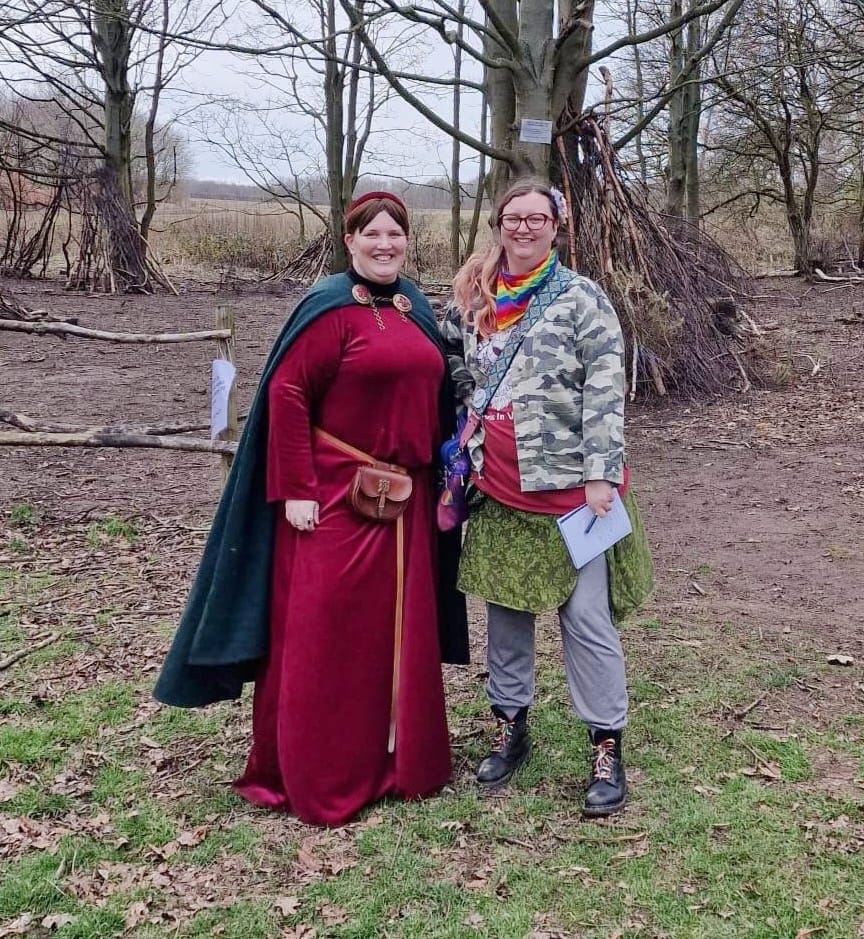
That’s me there, on the right!
Much like Eleanor, I have many skills, including the ability to build a time machine – which I did, to go back in time and meet her! Thanks so much to the Queen herself for showing me around some of her vast lands, unlike her rubbish son John Lackland (literally, lacking lands)
We had a lovely stroll where I got to ask her lots of questions and admire Sherwood Forest and it’s many ancient oaks. I also found out plenty about the history of the forest itself and the time of the Robin Hood tales – what was happening in England at that time. Of course the stories intertwine as Eleanor is indeed mum of both John and Richard – the former renowned for rising taxes to restore the money frittered away by the latter! I also learnt that if there was a Robin Hood, then he wouldn’t have been a fox. Dagnammit.
Designing the Miniature
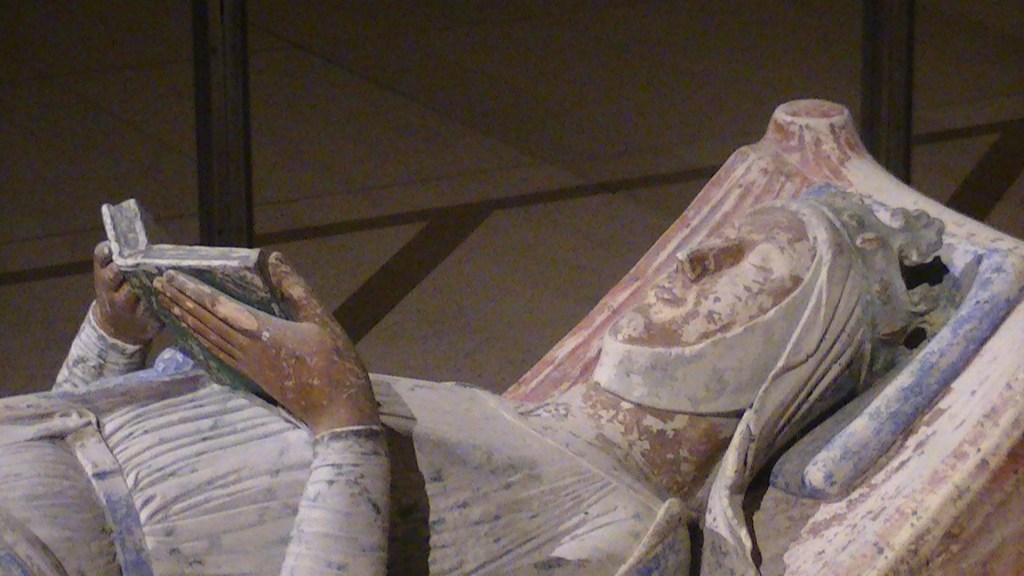
Effigy of Eleanor of Aquitaine in the church of Fontevraud Abbey [photo by Adam Bishop]
This took much longer than I imagined, because I got so fascinated with the history, and the back and forthing between rumour, myth and reality. While I know some were keen for a fighting Eleanor a la Angus Mcbride, storming to battle, I wanted to represent her more realistically, and to her strengths.
Of course the pre raphaelites adored the romanticisation of this era and she has been portrayed very much in a flowing locks fantasy princess sort of manner. I’m now getting quite good at medieval fashion, so drew on the information I already knew from researching Black Agnes, though different as she is earlier on. No tippets, for example!
Victorian depiction of Eleanor, which looked like it’s based off the tomb effigy.
In the Agnes post I was unsure on whether I had designed her in a wimple or gorget, and I can confirm it’s wimple for Agnes, Gorget for Eleanor! I wasn’t sure of the difference but get it now. The gorget is a bit like a helmet strap, not covering the rest of the neck. A chin strap.
A good likeness of Eleanor is her tomb effigy, which she commissioned in life, and shows her reading. I’m not sure whether this is a representation of her love of knowledge and literature, or The Bible, or both! But you know how attached I get to the people I research – if she wanted herself shown with a book, then heck yes I will grant her that! So the mini needs a book.
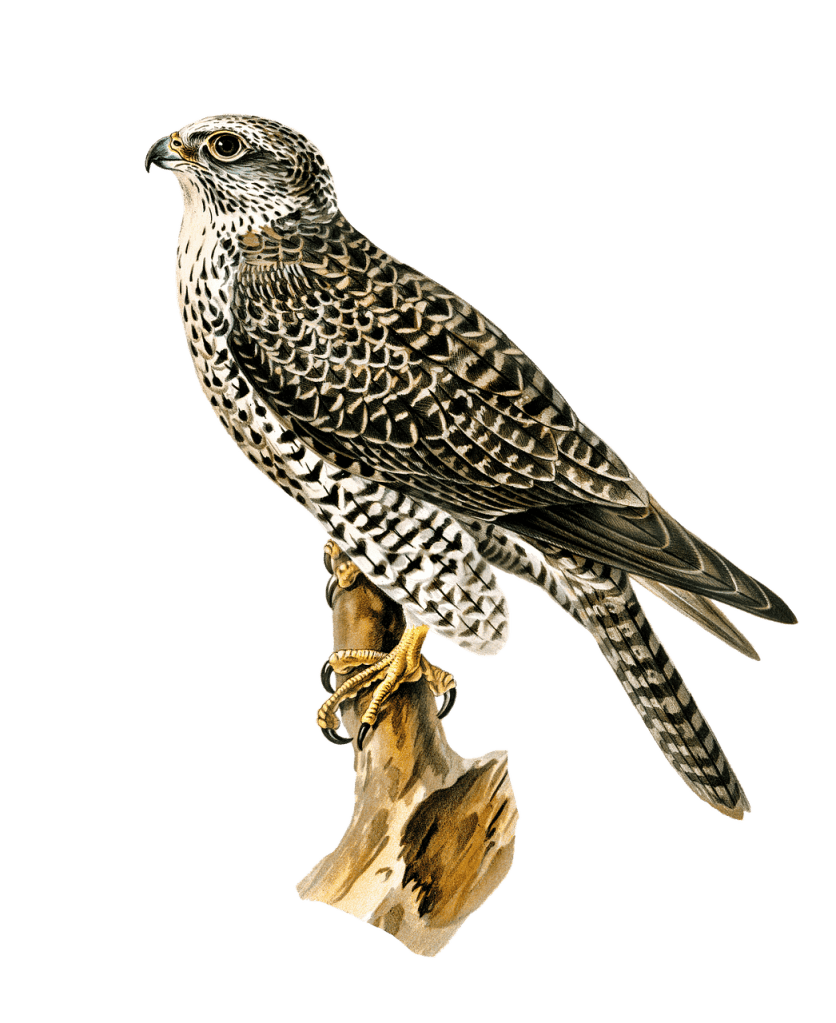
What else to ramp up her royalty? She’s sometimes shown with a falcon, and we love a good bird-on-arm pose right. So then I got into researching medieval falconry. As one does. The gyrfalcon was reserved for royalty, so definitely one of those. They’re also BIG, which helps for a mini, so it’s not just a lil hard to see thing, you won’t miss this.
Figure Design (c) Annie Norman 2023
A falcon and a book, what more could a gal want? A crown I guess a cape, and a cool dress, though I speak only for myself. And Eleanor! For the clothes design I have gone pretty much straight off the funeral effigy as it’s accurate. I found the cape fastening interesting as it’s very wide.
Regarding the pose, this took me the longest. Also to note: I can’t show you all the references used as I’m not sure 100% on a commercial blog what can be used, so I’m playing it safe. I looked up gyrfalcons of course, and found great photos of people holding them, and how they sit on a hand.
Controversially…. I didn’t want to put a glove on her. But you would really need one, those things puncture! I didn’t want her to be in the process of hawking, more posing with it as a status symbol, as if I was painting her portrait, which is kind of how I’m treating this project. I’ve chosen a perch which she is holding, so her hands are safe, it looks cool, and she doesn’t have a big distracting glove on.
Gyrfalcon
I had my housemate Andy pose in various different ways with the book, as we both walked around the living room holding books and walking looking totally normal to anybody passing by. Acting natural is hard! As with the effigy, I want it to be either representing The Bible or just something else she holds dear to her heart, so she would be holding it carefully and well…. dear to her heart. Nice symbolism Annie. Thanks, Me.
As with all my scribbles, the details are saved for reference pictures to the sculptor, so some aren’t needed, it’s more an idea of the final figure. I’m sure Alan will do something cool with the cloak and dress, so I don’t need to draw exactly where the folds are, for example.
I could keep typing forever but it’s been a long day! And I promised myself I wouldn’t go to bed til this is done, so sleep is winning. I also haven’t proofread this back so apologies if it’s inane ramble.
The sketches are getting better I think, that’s a good thing! Getting the hang of drawing on the tablet (ie directly on the screen) and prefer it to paper now.
What do you think? I wanted to keep this fairly classical but not be boring. As for wargaming figures, she will make a great leader character or on a shared base perhaps with King Louis in the Second Crusade, or King Richard in the third. Or just a cool queeny model.
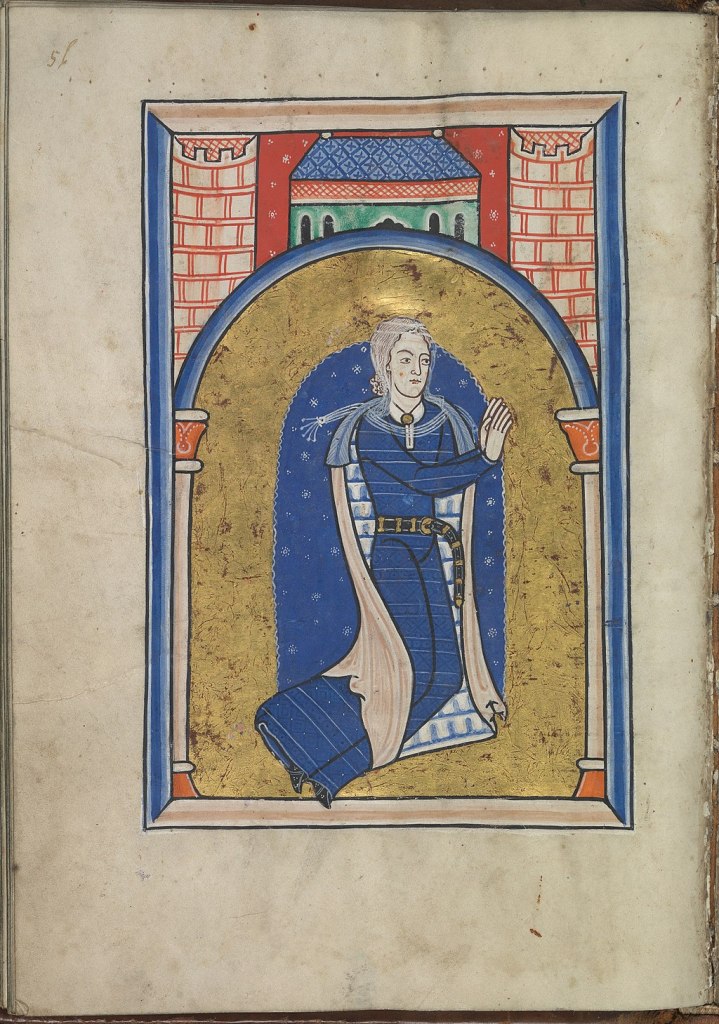
Donor portrait in a 12th-century psalter in the Royal Library of the Netherlands, thought to depict an older Eleanor.
Night night!
Edit: I didn’t want her to be reading the book as I didn’t want it to look like the tomb effigy had creepily just rose up to vertical!
I love how the first six miniatures are so all over the place in terms of time period and location. After finishing up in Scotland in the last post, we now jump on the Bad Squiddo blimp and land in Ancient Palmyra. Not today Palmyra unfortunately, as it is mostly destroyed. Dangit.
Empress Zenobia! 240 – 274[disputed]. This is a period I do not know a huge amount about… yet, so please do bear with me, and let me know what I get wrong! 300 years after Cleopatra, one of Zenobia’s claims to fame was that she was a descendent of the Egyptian Queen. Not a bad person to associate with in her situation, known for power and beauty!
A coin depecting Zenobia as Empress
Married to King Odaenathus, they ruled together successfully until his untimely demise – by poison. There were many suspects but the truth will never be known, so all we have is speculation. One suspect was Zenobia herself. What were her motives? Well his son by a previous marriage was above her in succession, and not long after the death she placed their son Vaballathus as King, with herself the Queen Regent. He was only 10 years old and most people have seen Game of Thrones by now and know how that goes.
Not much time passed before she decided to go against the Roman rule and forge an empire of her own. Zenobia forged a mighty campaign that saw the Palmyran Empire expand and engulf most of the Roman East, in a relatively short period of time. She was certainly not a passive leader and was reputed to be an expert on horseback and combat, and right there on the battlefield. An especially important victory was that of Egypt, where Rome’s supply of grain was from. Rome had been otherwise distracted around this time by other conflicts but then it turned it’s eye to Zenobia.
During this time, she had had currency minted with her own face on it, which I hard relate to as someone who keeps getting miniatures of herself sculpted. Annie coin?
Emperor Aurelian took exception to this challenger of Rome and a series of conflicts took place, which ended with Zenobia escaping on camelback but inevitably being captured. The rest is unknown – some say she took her own life a ‘la Cleopatra, others she was paraded through the streets draped in heavy jewellery in a mocking fashion. Another rumour is that she lived out the rest of her life fairly quietly married to a Roman, and had several more children. What do you think?
There is much more to her militaristic exploits but this is supposed to be a brief summary so I cut it short, but there is plenty of information out there if you were further interested. She appeared to be loved by the people, a good ruler, and ambitious and successful military leader, but Rome gets everyone in the end (Until it doesn’t)
Designing the Miniature
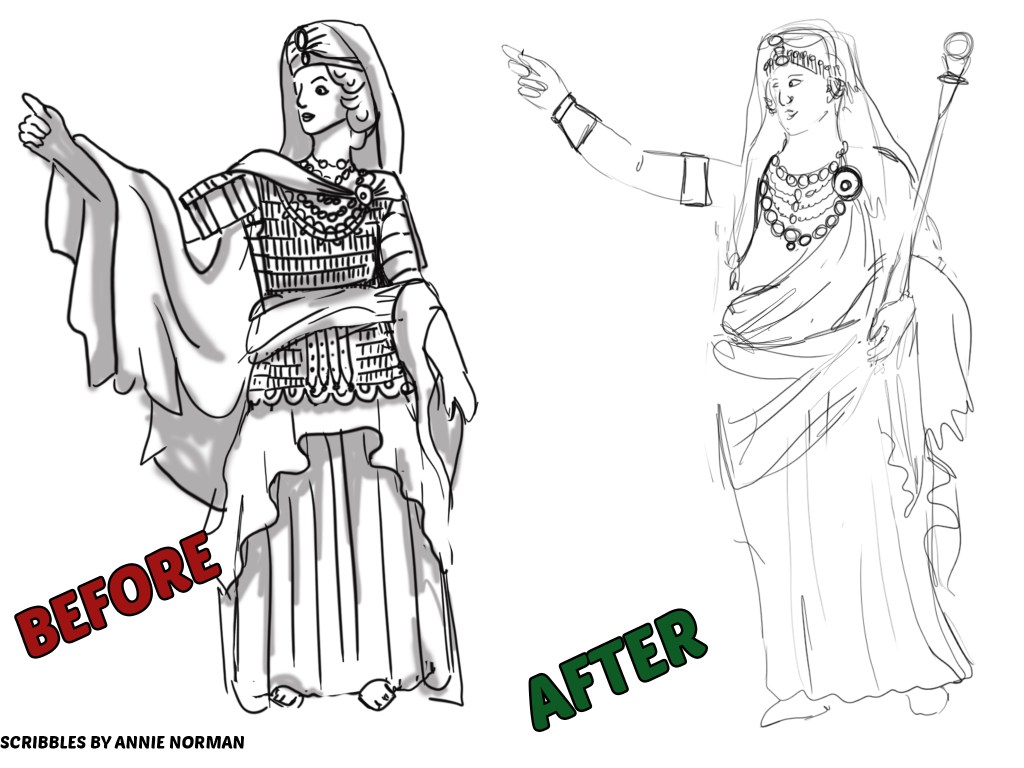
This has been a ride! Zenobia was the first miniature for this project that I attempted to design. It didn’t go down too great but really just needed some tweaks. I’ll show the first image with what I’ve changed it to.
Aside from the obvious difference of me figuring out sketching on a tablet better, it’s a much better design right? Also there are two years between these. I had a nice chat with Alan Marsh, our main sculptor (who will be doing all the community minis) about my terrible sketches, and he said he actually prefers the rougher, less accurate ones where he can “see my workings” at it conveys movement and what I’m going for better than anything too refined.
The pose looks a bit weird, I get it! It’s because it is based on this statue of Emperor Augustus, which looks much better from this side angle, I was originally looking at more of a face on and it didn’t show how the arm goes forward quite a bit.
Statue of Emperor Augustus
In the changes to my design I’ve lifted the arm to make it less awkward and added more elements of Augustus such as the sceptre and robe. I entirely removed the armour, as it was a while ago I can’t remember why I decided on that armour, but I was determined to how her combat prestige. Now I believe this can be done without literal armour and weapons, but definitely an alternative figure down the line of her in full Palmyran battle gear would be brilliant, and of course a mounted version (camel or horse though?).
Why the Emperor pose? Women are often depicted quite conservative in this era of statue, and Zenobia was an Empress, though not officially recognised by Rome, she earned that! I’ve designed this figure to look perhaps as she would like to see her self portrayed, even though it was her son she was calling Caeser. It’s like a very very belated present for her! That arm forward pose is very much associated with military leaders, and has been in many eras (just look at Napoleon on that rearing horse!) so I wanted to reference that.
“The Beauty of Palmyra” Tomb Statue
The head and torso are heavily based on this tomb statue called “The Beauty of Palmyra”. There are fantastically preserved tomb statues from Palmyra of this era, and the women often have this elaborate headpiece and veil. While Zenobia may have worn a different crown as leader, I really wanted to pay tribute to the people of Palmyra, such as this unknown lady, and the mixture of Palmyran and Roman influence I think, well, looks cool. This statue is the most elaborate I have found, so that is what I am basing it on. I appear to not be the first, as other artwork such as that by Angus Mcbride also seems to have been heavily influenced by it. And I’m all about that recognisable symbolism.
The robe has been simplified to more of a toga style wrap over a sleeveless vest. She is decorated in the bangles from the statue as well as a higher arm band in homage to her hero Cleopatra.
There are heckloads of jewellery because – she’s an Empress! Don’t worry about the detail, you’d be able to paint it gold then run a wash over it and BOOM, beautiful.
I believe my MK2 Zenobia is a vast improvement with not too many changes, what do you think? – Annie.
The last two entries have seen us in America, then France, and now we enter… Scotland!
Agnes Randolph (Ranulph according to contemparies but commonly referred to as Randolph, so will be by us for search results!) known as Black Agnes for her dark hair and eyes, is most well known for The Siege of Dunbar in 1338. She lived 1312-1369 making her around 26 for the time of the siege, now I feel somewhat underacheived!
As the wife of The 9th Earl of Dunbar and March, Patrick Randolph, early 1338 she came into the common situation of being left in charge of the castle while her husband was away. The English forces, led by the 1st Earl of Salisbury took this as an opportunity to siege the castle. What a great chance hey, while the man of the house was away, it must be a doddle!
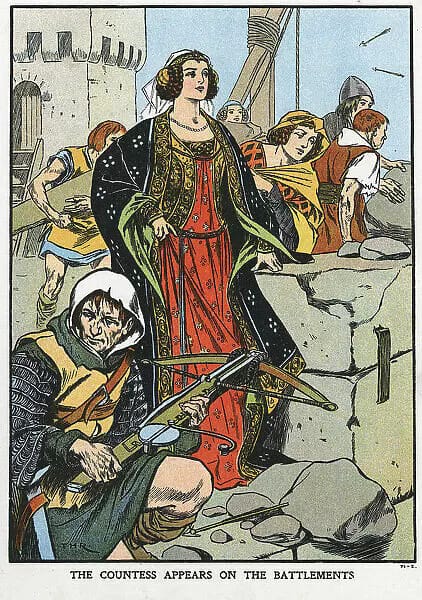
by Thomas Heath Robinson, 1910
The siege lasted until the 10th June that same year, a whole five months. The winner being…… Agnes and her castle full of awesome and loyal supporters and soldiers. Take that! There are various “fun” anecdotes of the siege, yes I know… a ….fun…siege anecdote? Sieges are by their very nature, horrific! But everyone loves an underdog tale.
At one point, one of the boulders launched over the walls was dropped back over the edge right into the top of a siege tower, crushing most the soldiers inside. They gave back what they got and much more! It is said that her handmaidens, dressed in their finest gowns would be at the ramparts flamboyantly dusting with lace handkerchiefs. This is the psychological warfare I can get behind.
Salisbury even threatened the death of her brother, to which she responded along the lines of “Whatever, I’m his heir anyway”, which reminded me of the tale of Caterina Sforza (who we make a mini of already!) where her children were captured and being threatened, she lifted her skirt, grabbed her crotch and declared that she possessed the instruments to make more. Casually brutal.
Cam I early, Cam I late, I found Agnes at the gate.
Designing the Miniature
This is another I thought would be straight forward as there are already great depictions of her already that are similar to each other. However I didn’t want to just duplicate without knowing why certain details are there. You know what I’m like, I want it to be right! So even if I do all the research and it ends up like the above picture, I will at least know why, and can explain it confidently.
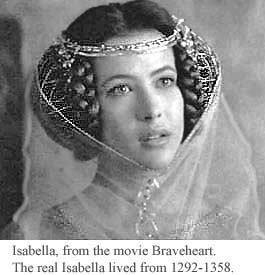
Hairstyle. Around this era it’s largely a variety of plaits tied around the head, sometimes with ribbons, and with nets or cages called crespines or crespinettes and a veil or wimple. I’ve decided to go with the almost Princess Leia style as it’s in almost every depiction I could find, and fits reasonably within the time frame. It’s correct enough and recognisable enough as Black Agnes. Unfortunately the best “photo reference” I could find is Isabella from Braveheart I KNOW PLEASE FORGIVE ME.
The circlet, hair and crespine are going to be the same, as they will look super on a miniature and different from our Jeanne de Clisson from the same era. The wimple will be different. I THINK it would be called a veil and gorget, as they will be separate, whereas a wimple is one piece, but happy to be corrected. Also the top of the hair covered by the veil.
Clothing. The kirtle (dress) will be quite plain with a surcote on top, sort of like a tabard. Tippets will add some detail, they are the ties of fabric above the elbow that drape down. The surcotes by this time were getting laced or stitched down the side, giving them a bit more of shape, so we’ll go for this. This will all be quite simple but allow for a manner of creative paint jobs.
Pose. I struggled with a pose but happy with the outcome! The tippets make it difficult regarding casting but I am probably overthinking it, I am sure there are minis in the range with the same sort of hanging strands! Having quite a closed body means they will be much easier to cast, but I might enquire about whether hand on hip would work. Tippets can be quite large so it could work – what do you think? Hand on hip or around waist? Forgive the mitten hands, they will look better! That’s quite a splayed hand on chest as a common laughing pose. Yes she’s laughing – you know I love a laughing mini. It suits her I think as “ha, call that a siege!”. The wimple/gorget is tucked in so you can see the nice hem on her dress, which laces up fairly low. There will be more waves in the surcote of course, not a solid cone!
La Maupin, L’Heroine Cover page of the French magazine “Le Matin,” 1910s
I’m back! We have a wild character today who I’ve been wanting an excuse to make a miniature of for so long, so her being chosen is excellent, hooray! Julie d’Aubigny was also know as “La Maupin”, that was her opera stage name. She was here from 1670 – 1707 though records vary and as we will come to see, her story is somewhat muddled into legend! Much like Mad Max (also always wanted to start a sentance with that) tales of her would have been spread by word and almost certainly been embellished or added to, crossed over with other events. For example “Did you hear they’re saying the boat was blown up by Mad Max I mean, La Maupin?” when she might have just been sat at home watching a painting.
However! Her story is cool enough that it warrents telling, and I’d like to think every single detail is accurate as it makes for a tale of awesome proportions.
Julie is known for being the sword fighting, opera singing, law breaking bisexual temporary nun. What a title. Taught to fence early on by her father, she was a handful from the beginning, and after a failed matchmake because the chap was too boring, she ran away and began her life of scandal. She made money basically by busking around with a mix of operatic singing and swordfighting demonstrations, which was of course a delightful spectacle for the public with her being a woman, so probably raked in some decent coin.
For most of her life, Julie dressed in men’s clothes, it’s impossible (probably) to know exactly why, as with many historical characters it could be for practicality and getting around town easier, it could be she had a different gender to that assigned at birth. The book “Female Husbands” by Jen Manion covers this topic really well. I’ll be referring to her as she/her as there is nothing to say the contrary.
Her story is a whirlwind of romance, stabbings and a very short attention span! She was pardoned by King Louis XIV TWICE. Once for burning down a convent (after romancing a woman who was sent to a nunnery as punishment then Julie joined the nunnery to continue the romance) and second for stabbing (some accounts say killing) a bunch of chaps at a Royal Ball. The first due to her dad’s status, the second because Louis just thought it was very entertaining.
Designing the Sculpt
To be honest, I was so tempted to phone this one in. I think partly because I spent so long on Harriet Tubman, it’s 6pm at time of writing, and I wanted to get all 6 done today (ha, sweet summer child) but I’m not too disappointed as I am really enjoying this, and starting was most of the battle. By “phoning it in”, the image above, at first, I thought was perfect! Very rarely do we just make a painting into 3D, but it being public domain and “would make a cracking figure” was very temping.
HOWEVER. Then I got down the rabbit hole of 17th century fashion! What a rabbit hole indeed. So first I looked up images of her, how other people had represented. Many were in skirts, which would make for great miniatures, but if she dressed as a man her whole life, it’s inaccurate. I will do some sword fighty dress ladies at some point though don’t worry.
This made the research all about late 17th Century Men’s Fashion. Which the more I looked, became more and more of a minefield. This was very peak “fashion” time. The wealthy were changing their minds every decade pretty much on what the look was going to be. Big boots to small shoes, big flappy trousers, tight ones, ruffs, cravats, everything!
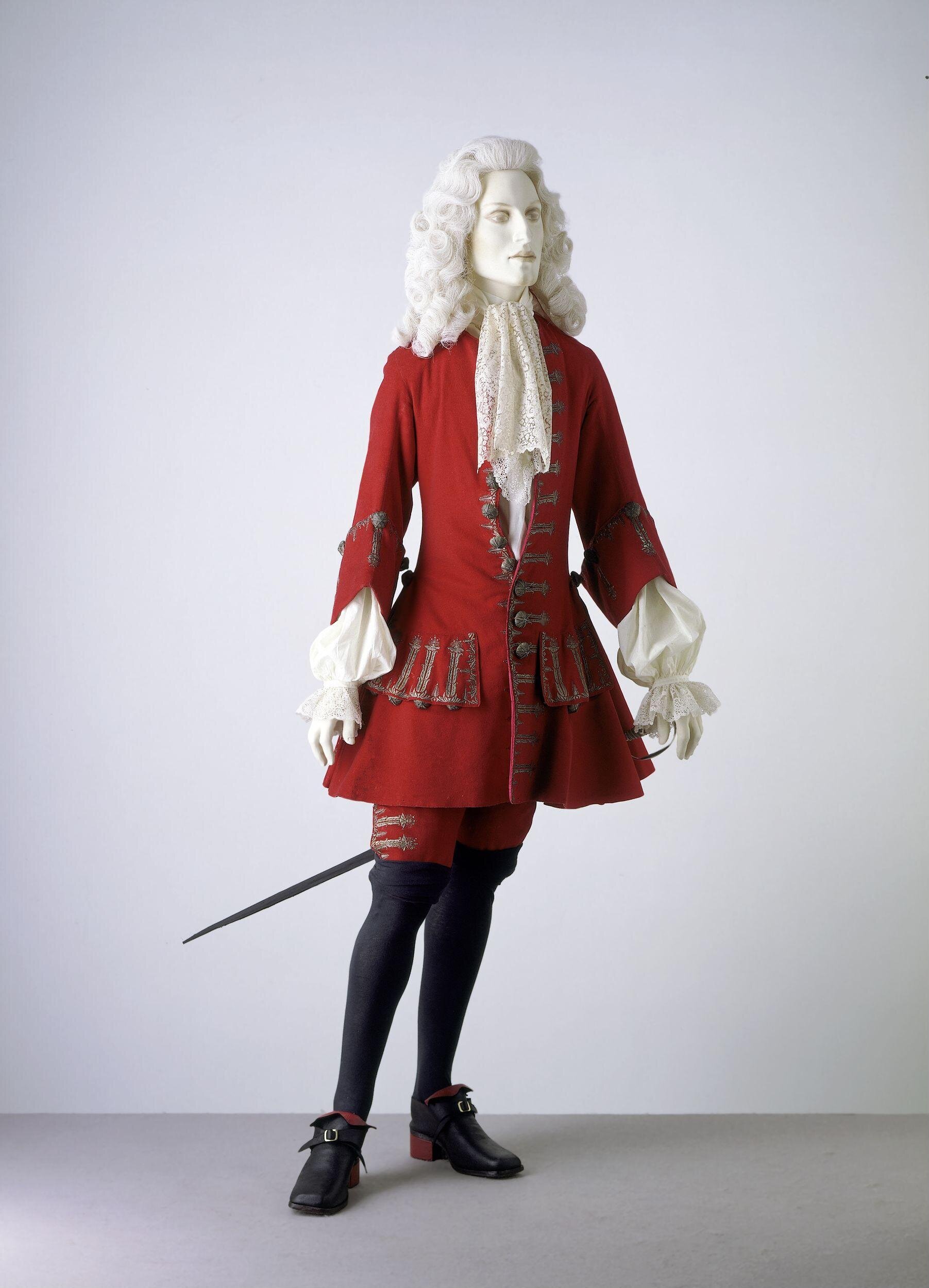
These were the closest I could find for around 1685-95 when a lot of the scandal was occurring! It really does change that quickly. The musketeer boots had gone out of fashion and the little red heels made popular by Louis XIV are just darling, so they’re going in. Justaucorps had replace the tighter doublet (of the first image), they were longer coats with a cinched waist. It was all less “flouncy” that a decade before, though still very elaborate compared to today’s tracksuits. The breaches no longer were as poofy and ribboned, as the coat covered them anyway.
Of course, all this fashion is for those of high society. I decided to dress Julie in the gear of a high society man due to her upbringing status, and the fact she was documented socialising at a Louis XIV Royal Ball. I figured with her other criminal activity, she may have done the odd theft to make sure she had enough to keep up with the times in a fashionable suit, and I get the impression she would have been quite proud of her appearance.
Ok it’s time for the reveal of my next terrible sketch. I am leaning into the terrible sketches now. Of course to the sculptor, this is accompanied with lots of descriptions and reference!
The pose is the same as the first image from the article. I think it’s great and suits the character. The clothes are a mixture of largely two of the clothing above, largely that of the khaki suit (which is part of the V&A collection) but with the actual justaucorps being from the one in red as you can’t see the other from under the cape. Leaving that undone to the belly button area I think will help with the shape, and it was a common way of wearing it.
Casting Concerns
I’m slightly concerned about the sword, even though it will touch the base making it stronger, I don’t know if it will be a liability, so I’ll discuss this with the caster and sculptor before we go ahead. It will be thicker than “at scale” as it would be needle thin, but I don’t want it to look like a big stick either! A workaround could be changing the wind so the cloak is floating behind the sword, a pose I am sure you are familiar with across many ranges! We shall see!
That’s all for now, I’m sure there will be an update on how we’ve adapted from the “first draft”. I am thinking of doing the Black Agnes write up next, but I’m going to have my tea and a walk first, before my eyes fall out. – Annie
Welcome back, the relaunch! I’ve kept the social media updated but not if you only follow here. I hit an absolute brain brick wall with this, and with the running of Bad Squiddo taking up all my time (and then some) it hit the backburner.
BUT! I promised I would get it caught up, so let’s do it.
I am aiming over the next couple of days to have all the designs and briefs sent to the sculptor, and then we can start voting for the next few and breathe life back into this. Thank you for being so patient and understanding.
Who was Harriet Tubman?
Harriet Tubman (born Araminta Ross), 1822-1913 began life as a slave, and ended life free. Once she had discovered the Underground Railroad – a network of people working to smuggle out slaves and free them, she joined up wholeheartedly. A Christian woman, she felt it was God’s calling, and her supporters eventually began calling her Moses, because of the similarities!
At the age of 15 she suffered a massive whack to the forehead, there are varying accounts of how it happened but it led to a lifetime of issues with narcolepsy and other brain injuries. She often had visions during these blackouts of what she should do next, which led to even more blessed status.
She never lost a passenger, the counts I can find vary between 70 and 300 people during these times. It was said she carried a pistol which was never used, but for potential self defence, and for asserting herself on times there were people wanting to turn back. Harriet would say “Move, or die”. While seeming harsh, this was in fact imperative to the mission and ensured everybody got to their destination safely.
While a short five feet tall, she was strong from the years of manual labour, mentally as well as physically, with childhood bronchitis giving her a low voice which worked well for administering sharp commands.
When civil war broke out, she joined the Union side as a nurse, but Harriet’s skills from delivering all these people became quickly apparent as she was then enlisted as a spy. She led 150 black American troops in the raid on Combahee Ferry, freeing 750 slaves in one go.
Harriet lived a long life and even had surgery on her skull in the later years, opting for no anaesthesia but just to bite on a bullet, like the civil war soldiers. What a badass.
The Miniature Design
With this information, how do we go about making her into a 3cm tall model, that can encapsulate as much of this as possible.
Let’s begin!
The Key recognisable items (not all required) that I noted was a lantern to lead the way – both literally and figuratively, her head wrap, a dress from a photo, her pistol, and funnily enough – chickens. One of her tricks was to have two chickens on a leash, and if she saw someone who may recognise her, she tugged it so the chickens would squawk and give her cover from all the flapping.
So a gun for sure. Some accounts say revolver but it doesn’t massively check out. There is a photo of her caplock pistol from the Civil War, so it seems right to honour that. Even if she didn’t use that prior to the war (part of the enlistment) it has become one of the symbols for her, and as I frequently say, mini making is often more about symbolism than literal duplicates. Also handguns at 28mm are teeny so it won’t make too much difference.
The lantern of lighting the way! It would have been a kerosene lamp around those times, of which there are many different designs but ultimately the same form. The gaps will need filling for casting but I know that Alan (the sculptor) will find a way to make it look great and still be castable. The handle will of course have to be thickened for the same reason. The bag is a standard bag of the time, and will be over the shoulder with other supplies and tools inside.
Pose
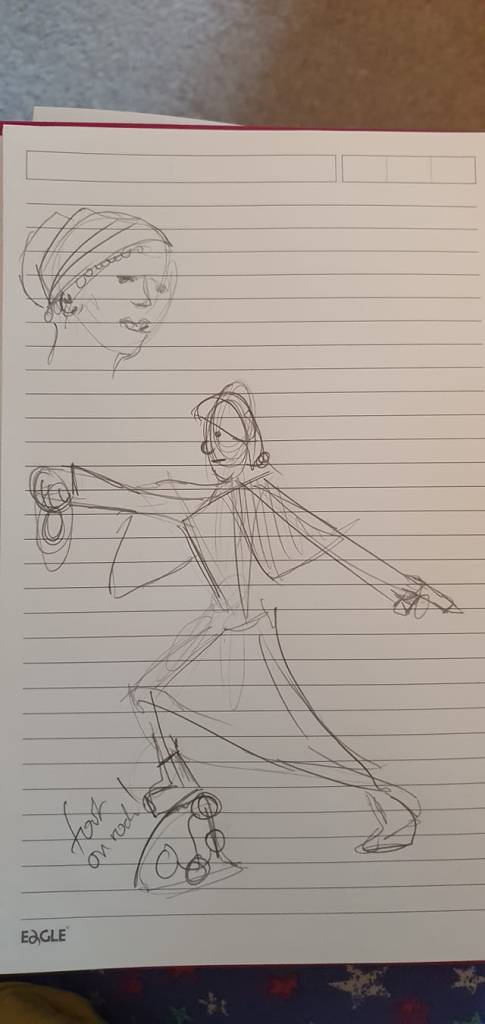
I wanted to show Harriet Tubman in a dynamic way, as is she is currently leading an escape. I didn’t want the gun to be too prominent as it would emphasise violence but adding it will make it a very useful miniature for various games and scenarios (also something to bear in mind!). I also had a hankering for the old “foot on rock” trope. We haven’t done that in a while!
So instead of a rock, it’s going to be rubble, perhaps symbolising the impending collapse of slavery, with some broken shackles in there, which she is trampling over.
Some depict her in a coat, others in a shawl, though there are no photos, apart from later in life where she has a beautiful but not practical shawl. I’ve gone for shawl as one of her disguises was an an old lady (before she actually was!) so it’s a reference to that. It will be more jaggy than shown there, but remember these are just very rough sketches for a sculptor who knows me very well indeed!
There is a note with the left arm that the pistol doesn’t need to go back so far, in fact in might look a bit unnatural, so it may end up more forward and closer to the body.
Note on terrible drawing: Especially as I am behind with this, I’m not wasting time honing any drawings for the sculptor – concept art just has to let the next person in the chain know the needs and musts, and this alongside with my notes is enough for Alan, and he’s worked with a lot less before! I think we have a psychic link at this point.
The photos of the gun, dress, Harriet’s face, bag and lantern together with my little playmobil style drawing are enough to piece together a cracking model.
What do you think?
Onto the next bit of research for me…. more coffee! – Annie














 Community Miniatures Project