
If you haven’t already read about my visit to see actual Ada Lovelace in person, then you should totally go and read that first.
As is now tradition with this project, I ended up way off track, spending a whole evening figuring out what the Analytical Engine WAS, and the purpose of punch cards. Some of you older folks (older, not old!) have helped to inform me on those, as it was a lost tech by my time!
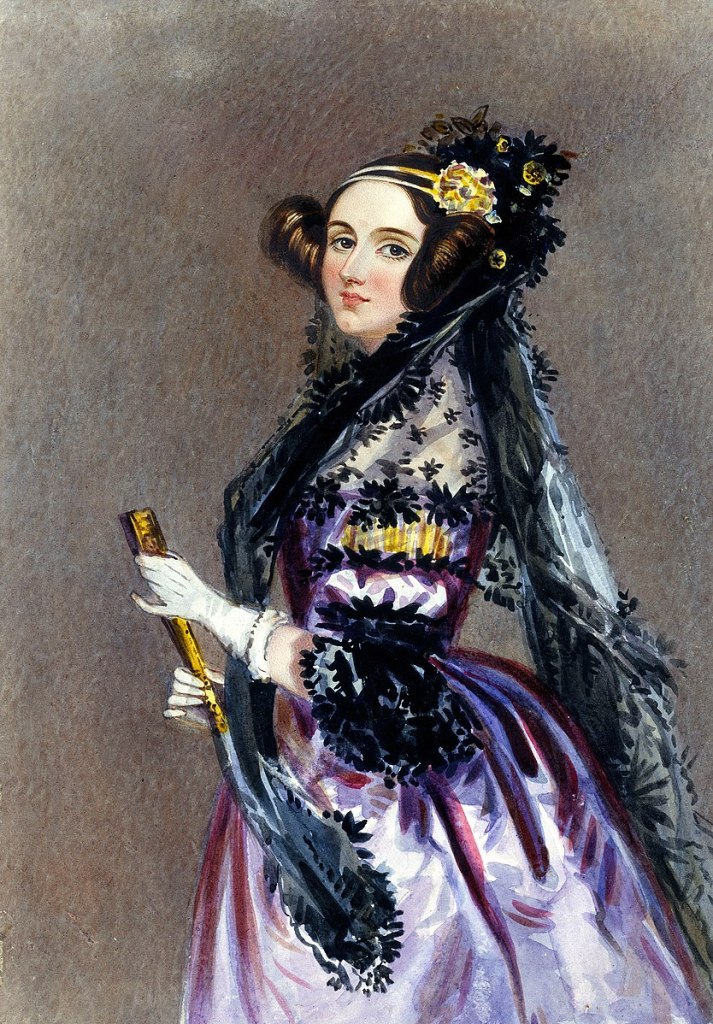
Ada Lovelace (born Augusta Ada King 1815 and died 1852) is a very well-known mathematician, recognised as being the very first computer programmer. She worked with Charles Babbage on his Analytical Engine, which was, in basic terms, a massive calculator slash early computer. It was theoretical, so they did not build it, but Ada’s annotations and calculations became the foundation for much of the technology we use today. We can blame her for those danged algorithms, she published the first one in 1840.
The daughter of “mad, bad and dangerous to know” Lord Byron, she was kept away from her father and the arts by her concerned mother Anne Isabella Milbanke, Lady Byron. Fearing the arts would corrupt her into the debauchery of her lineage, Ada was given a very scientific and mathematical upbringing by some of the best tutors available.
Designing the Figure

From the start, I knew I wanted her to be wearing very fancy hair and dress as she was often portrayed wearing, most famously in the painting by Afred Edward Chalon. However, I don’t want her to be static.
Figuring out how to show someone “doing maths” can be quite the head-scratcher – which incidentally was a pose I pondered! But she was far more than any standard mathematician, and I wanted her to be more unique.
The “ah ha!” moment came with the punch cards from the Analytical Engine. Upon researching statues of Ada, I came to the conclusion that others had had the same idea and the same struggles! A fantastic piece by Etienne and Mary Millner, I can almost hear them going “argh just hang the punch cards up behind!”. I feel the struggle.

So let’s get to the Annie sketch. I feel she will work holding the cards up, perhaps quizzically, studying them. Regarding casting, they can almost cascade down her arm, something I am confident that the sculptor will figure out. They would need to be shorter at the very worst, but I think this is unlikely. I’ll get him to indent some holes into them, well – divots, so an ink wash will fill them in for you.
The veil in the painting will be harder to translate to a solid sculpt, as I have noticed from the more enormous public statues they have removed this, and we will too. It works beautifully in paint as it is translucent, but it would be quite a solid block in metal, especially at this scale.
I think this will make a lovely miniature to paint, and people can get really creative with the dress fabric, or if they are daunted, can paint it a solid colour with a wash and have it still look lovely.
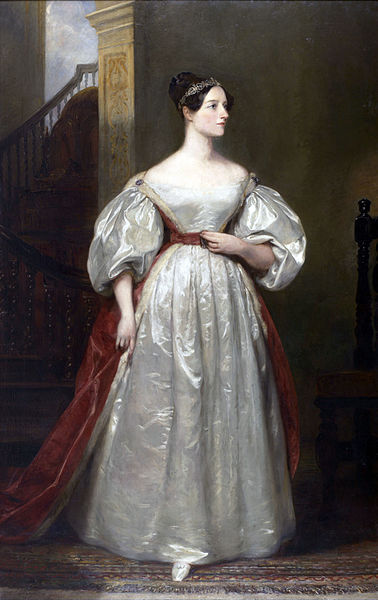
Regarding the dress, there is another painting which shows her front on. It is a different dress to the purple, but I intend to converge the design to make something which works well. Splay the bottom of the sleeves and add those delicate gloves.
That’s all there is really for the design of Ada Lovelace. Anything else to note? Oh, the weird hand in the sketch! I am very tired and figured I could wind myself up trying to figure out the hand for the rest of the evening, or just tell the sculptor what I meant, and he’ll do it fantastically! Wahey! That’s the process, folks!
I am very much looking forward to seeing a lady in a massive fancy Victorian dress figuring out complex maths thingies. Yes! Are you?
 Community Miniatures Project