Designing Jeanne d’Arc

So here we go! If you missed Part One, check this out first. What do we know, first of all? Well, she wore men’s clothes. She has been depicted in dresses and skirts, but that’s more the symbolism, and we want to go as accurately as we can. I also wish to make figures that the historical person would approve of if they could see it somehow; come on Bill and Ted – lend me that time machine! She DIED because of her insistence on men’s clothes, so she’s getting them in 28mm! We won’t give her a helmet as we want to see her face, the face that grown men would have seen on the battlefield.

John Everett Millais – Joan of Arc, 1865, Very much in the Pre-Raphaelite style

In the variety of depictions, Jeanne has much in common with Eleanor of Aquitaine. They’re both shown highly stylised and dressed in what was a fashionably romanticised notion of her period at the time. I see this as a positive; you can see how they evolve over time yet keep the same key components, such as the banner and armour, in Jeanne’s case. It’s not historically accurate, but it is an insight into history in its own way.

I know some folk will want to see her hacking and slashing her way up a rampart, but this also goes against Jeanne’s position. I, too, wish to see more hack-and-slash medieval ladies, but you have to vote for them! We do have Jeanne de Clisson currently, but more would be a dream. Jean Hatchett very closely made it last time, perhaps on the next voting rounds? As I mentioned in the Eleanor of Aquitaine post, it’s good to keep them as much “themselves” as possible, instead of putting them into a different role.

To the Armouries!

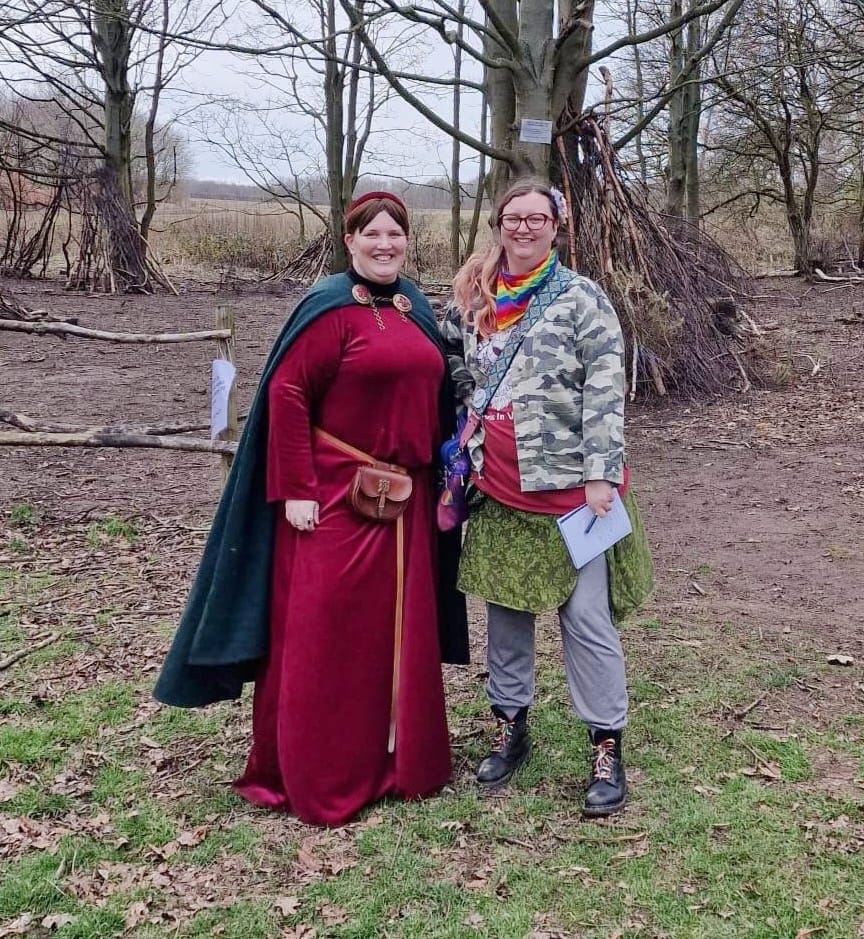
After giving myself a headache looking at all sorts of armour, I decided to go to The Royal Armouries in Leeds for some hands-on research. Sculptor Alan Marsh came along!
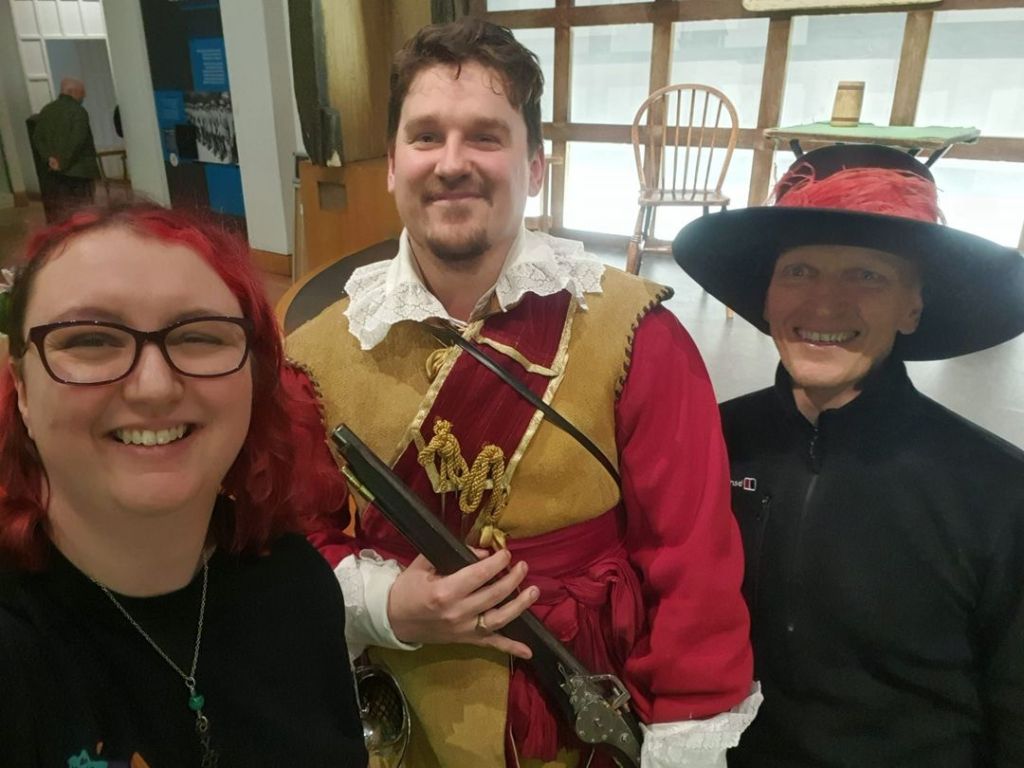
L-R Me (Annie), Richard of ECW knowledge, and Alan: not his usual hat.

It was a superb chance to catch up and nerd out with many history chats over coffee and a delicious roulade. For a second time, I was impressed by how many books about women in history the gift shop has, which is even more than last time I was there. Of course, I had to buy some…

It’s brilliant to discuss upcoming figure design while in front of the actual pieces and, of course, feel the weight of different weapons. This all helps with the sculpting process to bring you these awesome-cool minis.

The Banner
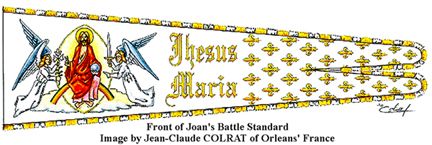
Essential in Jeanne’s “kit” is the banner. She had several; important ones for us are the battle standard and the pennon. The battle standard was enormous and too unwieldy on foot, requiring a special saddle to prop it in. If we make a mounted version (I really want to, please buy loads of this to convince me!) we will use that for sure.
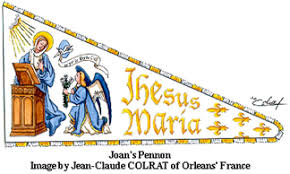
The pennon is the foot version, carried on a shorter pole and what she would have had to be mobile without her horse. With the mega battle standard, she wouldn’t be able to walk about.

When considering the pose, I figured that even though this is smaller, she would probably not be strong enough to hold it in the air one-handed, so it will be resting on the ground.
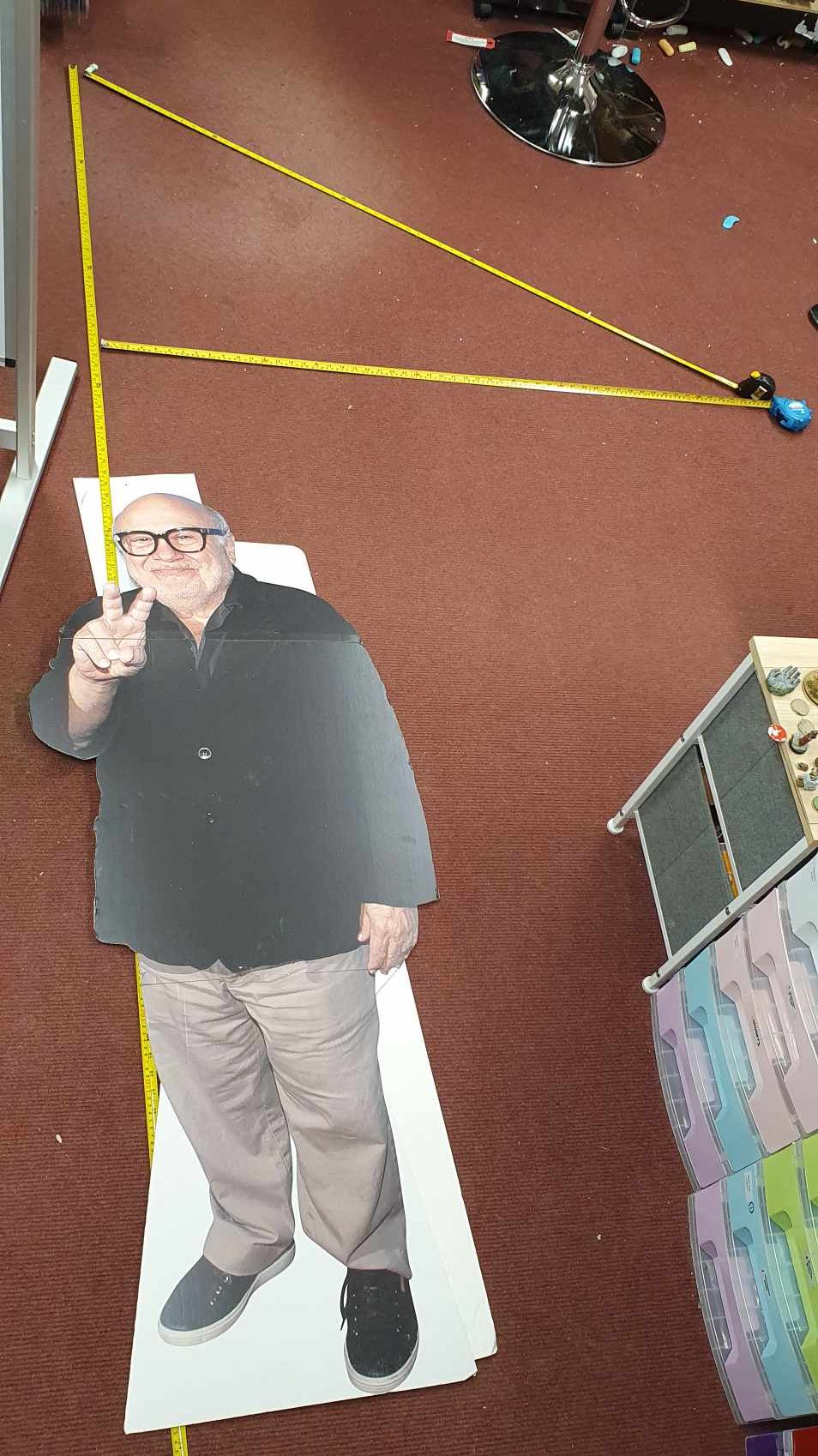
I found the measurements of both flags, so first I lay out the size of the pennon and needed something to help scale, and who better than Danny Devito?

There’s always a debate between cast banner and wire spear with transfer/paper. I have mulled this over for A LONG TIME. Cost is a significant factor, with these minis being £5 each, a big wavy bit of metal adds to the cost considerably. They can also become really clunky. I really want people to have their own unique Jeanne banner, and not a generic 15th century knight, so considered the possibility of getting a transfer made, but this is hard to apply along folds and creases of something sculpted.

Then, I mucked about with a wire spear and the paper we use for leaflets which found it to be a perfect thickness. I never did understand applying transfers to paper, when you could just have the paper printed in the first place. This would be a better quality than standard printer paper as well. So it’s now escalated to pricing up what the cost of our own designed pennon AND battle standard would be, as we might as well do both simultaneously, right! That mounted figure is happening whether I like it or not, isn’t it… (ha I protest too much for sure).

“I love my banner best – oh, forty times more than the sword! Sometimes I carried it myself when I charged the enemy, to avoid killing any one.” – Jeanne during her Trial.

Armour
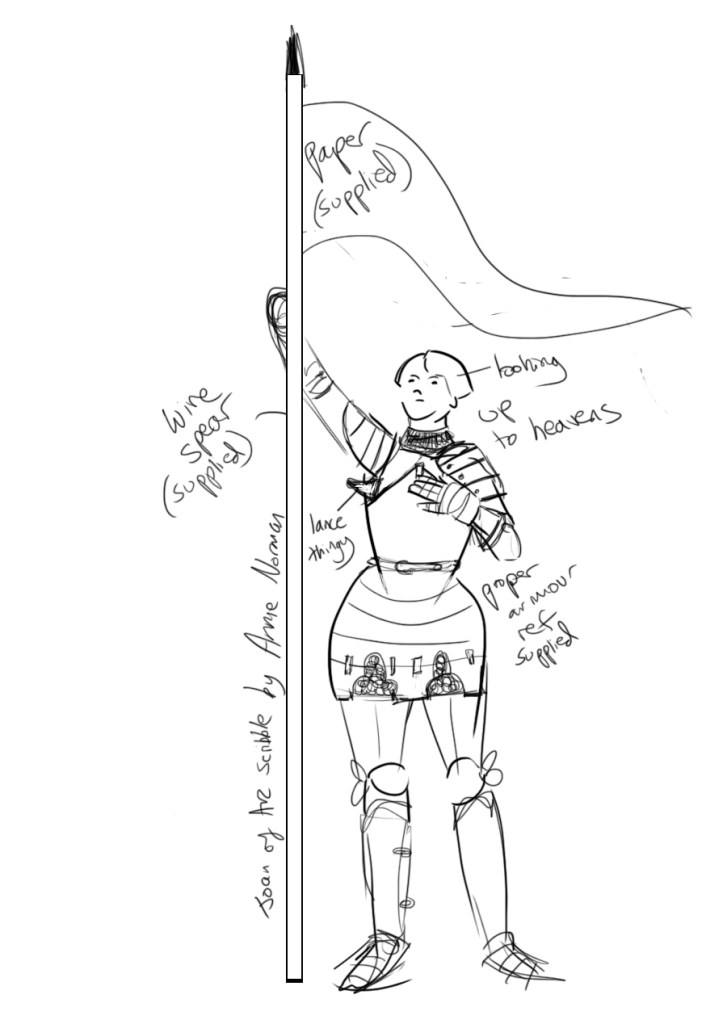
Figure Design by Annie Norman, 2023

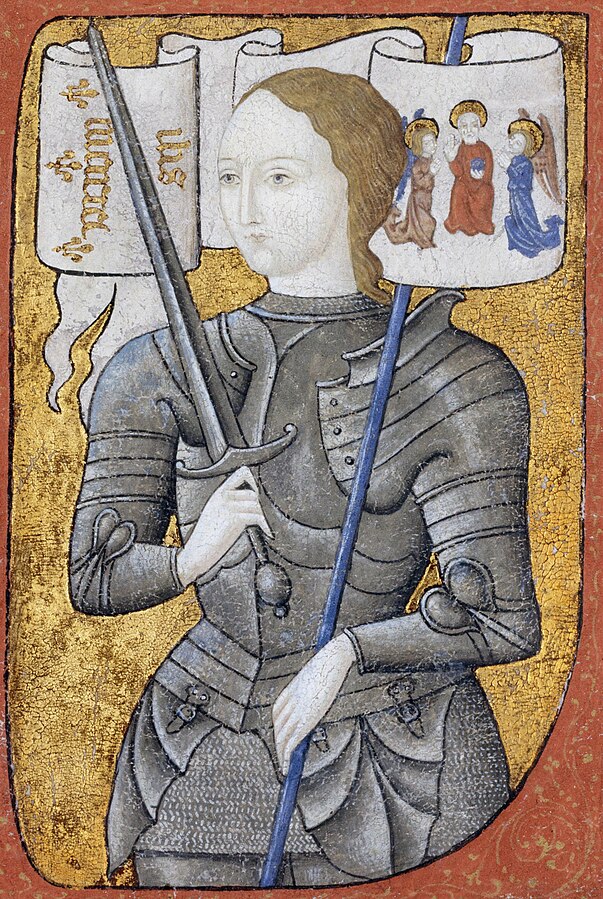
Several contemporary references to Jeanne being in “White Harness” armour exist. The white part means that it wasn’t embellished (Sorry Millais) and the harness part is that it is in many separate pieces. Jeanne was first given an “all in one” armour, then used some found Burgundian armour, and then was eventually commissioned this lovely piece by Charles VII. So that’s what I want to put her in.

It’s important to me that the pose is very much lifting the eyes upwards; Jeanne is holding the banner as high as she can so everyone can see, and she’s looking to the heavens for reassurance. These are all little signs that it is Jeanne d’Arc.

The hand-on-chest pose is used in several of the paintings and statues, and I appreciate the gentleness of it. However, in these, she is often shown bare-handed, I hope the gauntlets still have the same effect!
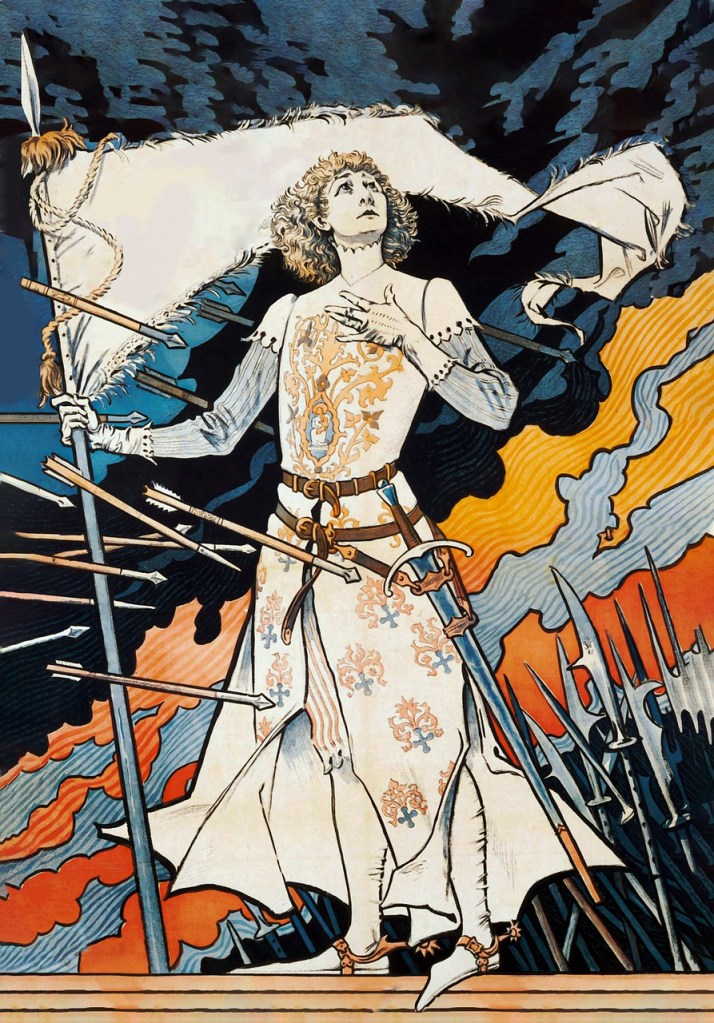
Eugène Samuel Grasset version of Jeanne

Something missing from my scribble is… The Holy Sword! That will be hanging from the scabbard, sheathed. Jeanne’s sword was the “Sword of St. Catherine”. A companion of Joan’s on the way to Orleans said, “I wanted to sharpen that old blade, but she said it was not necessary, as she should never kill anybody, and should carry it only as a symbol of authority.”

For the hair, we’re going for a shaggy bob, again to stand out more than a full “short back and sides”. This is one of the artistic decisions to make minis less literal sometimes, but not too far off reality – for example long flowing locks would be far off! A grown-out, super short hairdo is more justifiable.

I’m cutting this short as I feel like I’ve lived non-stop Jeanne for the last month and there is SO MUCH more I could write, but we’re nearing the end of the calendar year and I am sleepy, with more blog entries to complete!

The goal is to have these last two sculpted by the end of the week (ish) and then we can get voting on the next two between Christmas and New Year. Hooray!

What did Jeanne d’Arc actually do?

Here we go. Strangely, this is the figure I am most nervous about designing so far. Joan of Arc, or Jeanne d’Arc is known and beloved by many, and perhaps THE most famous military woman in history, if not a solid top-five contender! She’d be a winning answer in Family Fortunes.

Jeanne D’Arc being excellent

The nerves come from this, that people have their own idea of who Jeanne was, what she did, and what she looked like. She’s a household name and has been portrayed in so many movies (of course, most memorably in Bill and Ted’s Excellent Adventure), some more faithful to historical records than others.

Jeanne d’Arc was born in 1412 CE, during the Hundred Years War, a long and bloody conflict between England and France, which she would be destined to shape. From a young age, she began hearing what she believed to be the voice of God, though there are attempts at modern diagnosis to explain this on a secular level. We will never know, as per the words of Ridley Scott “Were you there mate?”

This led her on an incredibly daring mission to ensure that Charles VII (currently the dauphin) was to be crowned King, and then his army could save France. The fact that a young girl could walk up to somebody so high ranking is wild enough, but the fact they [eventually] paid attention is even more fantastic. “Scuse me, Sirs, you’re doing war wrong”.

Jeanne led the French Army through highs and lows in the pushback against the English, becoming a mighty hype for morale, waving her banner and yelling for them to push on. An army believing they have God on their side is exceedingly powerful. While it was unlikely she would have fought intentionally, due to her age, size, and lack of combat training, Jeanne’s presence and encouragement were where her power really lay. In wargames, we have rules such as “Inspiring Presence” for banner bearers, and it really was just that!

Jeanne as portrayed by Milla Jovovich in “The Messenger”, 1999

After a defeat at Margny, she was captured, after pretty much being abandoned by the King she helped create and put on trial by a mixed jury of French, English, and their French allies – the Burgundians.

The trial was as you can imagine – incredibly unfair. However, Jeanne was brilliant (the record of the trial is actually online) and managed to make it through the thorough questioning. What I find bizarre, about the entire odd tale, is they effectively “got her” in the end for her trousers. She insisted on wearing men’s clothes to show she was a soldier, the same as others, and under the direction of God. Crossdressing was seen as blasphemous so she was sentenced to death. Refusing to refute her Mission from God, Jeanne d’Arc was burned to death before a public audience on May 30, 1431, aged just 19.

I normally keep these summaries reasonably brief, to encourage people to read more, but there’s a bit more this time. Sometimes a story or figure can become so well-known that you actually forget the details. So there’s a refresher! There is course far, far more to the story, but that’s the jist!

Designing Jeanne d’Arc

You know what? I’m putting this into the next entry, as this is fairly long, and I have a BIT more research to do. Keep them hungry, as they say!

-Annie.

Designing Eleanor of Aquitaine

Living a long life from 1122 to 1204, Eleanor managed to reign as Queen of both France and England and is known as a fierce forward striking intellect, as well gentle lover of the arts. I have absorbed so much information on her life and influences during my research that it will be hard to keep short! Also apologies if this isn’t written as well as the others, I wrote a huge chunk, time passed, then came back and edited it heavily once I had learnt much more.

As with many women around this period in history, she is often noted for the men she was connected to, especially her husbands and sons, which can make research frustrating for wanting to find out about her in agency as her own person. The books I have found the best for this research as those by Alison Weir and Sara Cockerill.

She was married to Louis VII of France and then Henry II of England, with her sons Richard and John later becoming Kings of England (and her other EIGHT children basically all being high up somewhere or other!). The first two lumps of power being by marriage and the third by motherhood, she also came with her own inherited wealth. This made Eleanor very sought after as a bride, as well as victim to various plots and rumours to discredit what was an incredibly powerful and influential woman.

Indeed most of her actions of influence seemed to be based around this knowledge and skill of networking to build allies, therefore making herself and her descendants stronger. This is while her male counterparts were doing the more visible (therefore praised) work. For example, Richard I is known for being one of the greatest kings of England but in his 10 year reign was in this country for no more than six months. The country mysteriously ran itself. Oh no wait, there was a woman! Queen Eleanor!

Later in history she started getting the recognition she deserved, though like many of the women we cover, it’s never to the same extent, which is a large reason why we do this. Many will know the name, but not the deeds or legacy. Even 16 years imprisonment by her own husband (Henry II) didn’t stop her ambition. There are also a lot of myths around Eleanor to romanticize her, which can take away credit sometimes of the things she actually did do – like riding through the Pyrenees to escort Berengaria of Navarre to Sicily to marry her son, King Richard I….AGED 70.

My eyes twinkled when I read Niketas Choniates accounts of her riding to the Second Crusade in a golden dress with handmaidens dressed in men’s armour, but Sara Cockerill took the joy away by basically debunking it as non contemporary with no other mentions, and not referring to her by name. Boo. However, this again shows how we view the literal front line battle fighting as such a huge glory, which has definitely been hammered in through patriarchal history, whereas often it is though who never drew a blade who had the most impact.

Meeting Eleanor!

That’s me there, on the right!

Much like Eleanor, I have many skills, including the ability to build a time machine – which I did, to go back in time and meet her! Thanks so much to the Queen herself for showing me around some of her vast lands, unlike her rubbish son John Lackland (literally, lacking lands)

We had a lovely stroll where I got to ask her lots of questions and admire Sherwood Forest and it’s many ancient oaks. I also found out plenty about the history of the forest itself and the time of the Robin Hood tales – what was happening in England at that time. Of course the stories intertwine as Eleanor is indeed mum of both John and Richard – the former renowned for rising taxes to restore the money frittered away by the latter! I also learnt that if there was a Robin Hood, then he wouldn’t have been a fox. Dagnammit.

Designing the Miniature

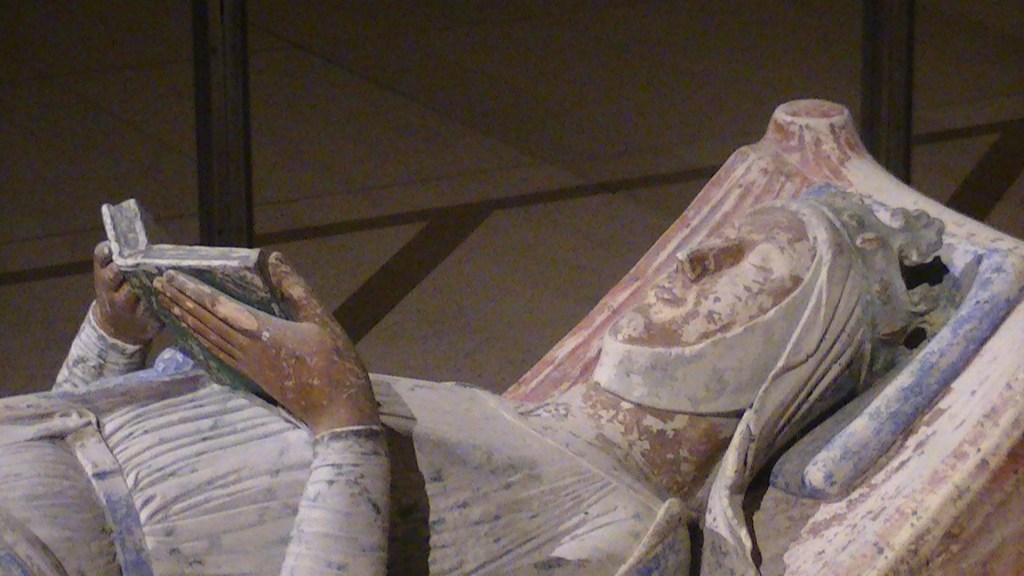
Effigy of Eleanor of Aquitaine in the church of Fontevraud Abbey [photo by Adam Bishop]

This took much longer than I imagined, because I got so fascinated with the history, and the back and forthing between rumour, myth and reality. While I know some were keen for a fighting Eleanor a la Angus Mcbride, storming to battle, I wanted to represent her more realistically, and to her strengths.

Of course the pre raphaelites adored the romanticisation of this era and she has been portrayed very much in a flowing locks fantasy princess sort of manner. I’m now getting quite good at medieval fashion, so drew on the information I already knew from researching Black Agnes, though different as she is earlier on. No tippets, for example!

Victorian depiction of Eleanor, which looked like it’s based off the tomb effigy.

In the Agnes post I was unsure on whether I had designed her in a wimple or gorget, and I can confirm it’s wimple for Agnes, Gorget for Eleanor! I wasn’t sure of the difference but get it now. The gorget is a bit like a helmet strap, not covering the rest of the neck. A chin strap.

A good likeness of Eleanor is her tomb effigy, which she commissioned in life, and shows her reading. I’m not sure whether this is a representation of her love of knowledge and literature, or The Bible, or both! But you know how attached I get to the people I research – if she wanted herself shown with a book, then heck yes I will grant her that! So the mini needs a book.

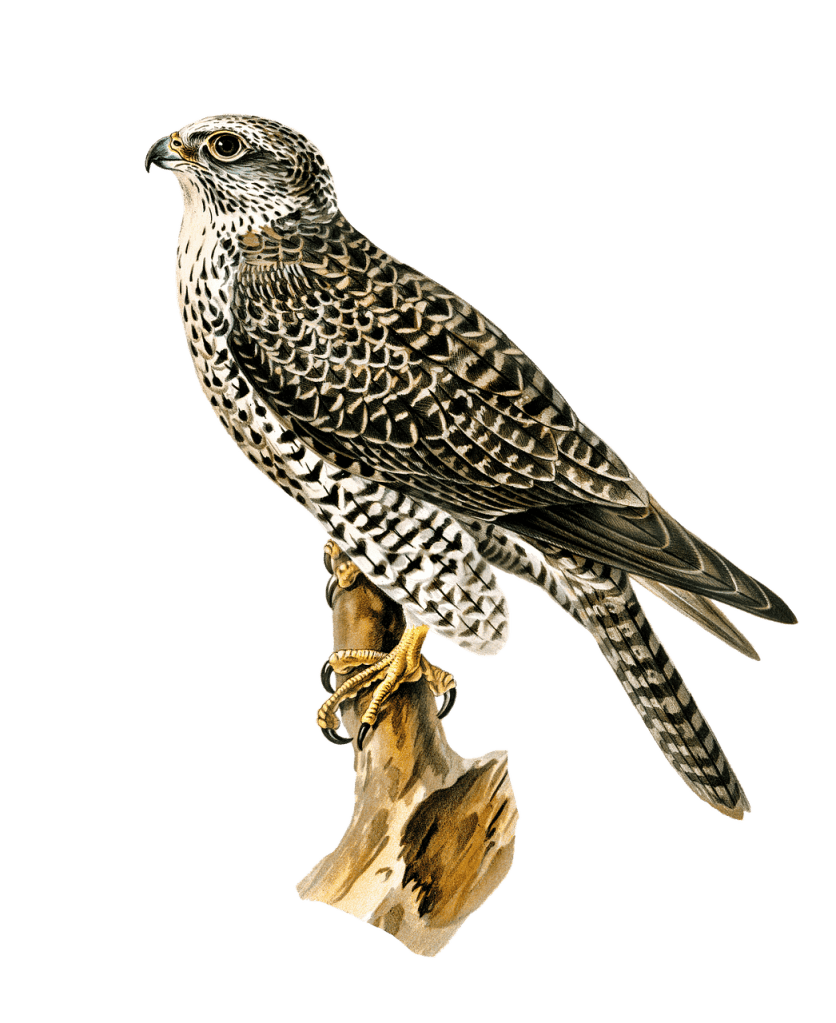
What else to ramp up her royalty? She’s sometimes shown with a falcon, and we love a good bird-on-arm pose right. So then I got into researching medieval falconry. As one does. The gyrfalcon was reserved for royalty, so definitely one of those. They’re also BIG, which helps for a mini, so it’s not just a lil hard to see thing, you won’t miss this.

This image has an empty alt attribute; its file name is eleanor-sketch-copy.jpg
Figure Design (c) Annie Norman 2023

A falcon and a book, what more could a gal want? A crown I guess a cape, and a cool dress, though I speak only for myself. And Eleanor! For the clothes design I have gone pretty much straight off the funeral effigy as it’s accurate. I found the cape fastening interesting as it’s very wide.

Regarding the pose, this took me the longest. Also to note: I can’t show you all the references used as I’m not sure 100% on a commercial blog what can be used, so I’m playing it safe. I looked up gyrfalcons of course, and found great photos of people holding them, and how they sit on a hand.

Controversially…. I didn’t want to put a glove on her. But you would really need one, those things puncture! I didn’t want her to be in the process of hawking, more posing with it as a status symbol, as if I was painting her portrait, which is kind of how I’m treating this project. I’ve chosen a perch which she is holding, so her hands are safe, it looks cool, and she doesn’t have a big distracting glove on.

Gyrfalcon


I had my housemate Andy pose in various different ways with the book, as we both walked around the living room holding books and walking looking totally normal to anybody passing by. Acting natural is hard! As with the effigy, I want it to be either representing The Bible or just something else she holds dear to her heart, so she would be holding it carefully and well…. dear to her heart. Nice symbolism Annie. Thanks, Me.

As with all my scribbles, the details are saved for reference pictures to the sculptor, so some aren’t needed, it’s more an idea of the final figure. I’m sure Alan will do something cool with the cloak and dress, so I don’t need to draw exactly where the folds are, for example.

I could keep typing forever but it’s been a long day! And I promised myself I wouldn’t go to bed til this is done, so sleep is winning. I also haven’t proofread this back so apologies if it’s inane ramble.

The sketches are getting better I think, that’s a good thing! Getting the hang of drawing on the tablet (ie directly on the screen) and prefer it to paper now.

What do you think? I wanted to keep this fairly classical but not be boring. As for wargaming figures, she will make a great leader character or on a shared base perhaps with King Louis in the Second Crusade, or King Richard in the third. Or just a cool queeny model.

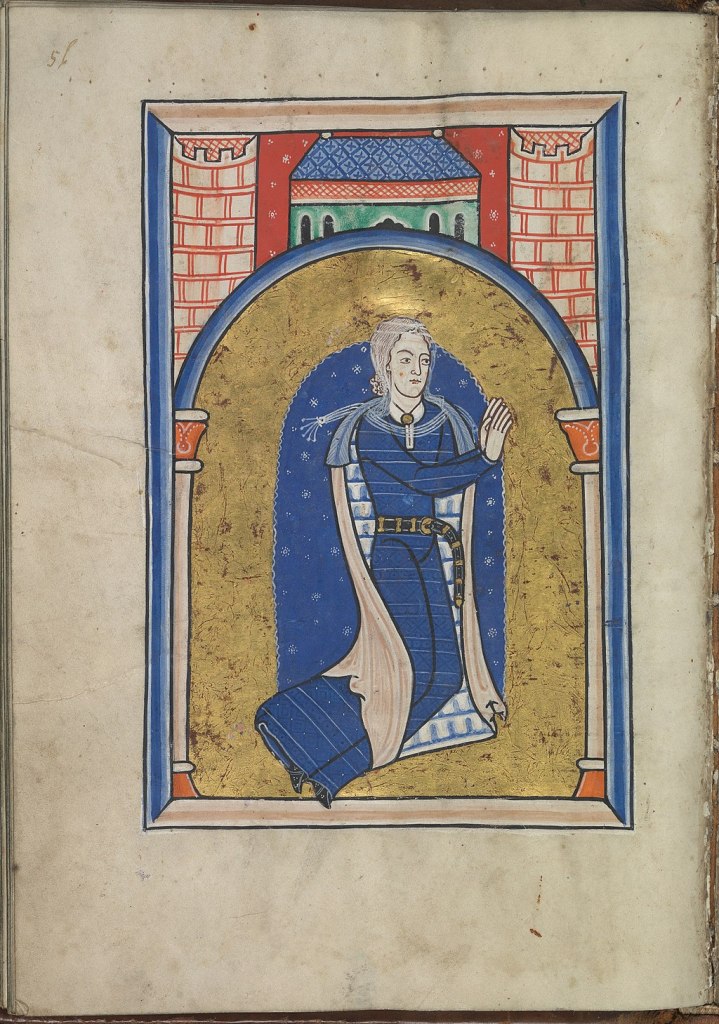
Donor portrait in a 12th-century psalter in the Royal Library of the Netherlands, thought to depict an older Eleanor.


Night night!

Edit: I didn’t want her to be reading the book as I didn’t want it to look like the tomb effigy had creepily just rose up to vertical!