Who was Saint Olga of Kyiv?

St Olga by Mikhail Nesterov in 1892, public domain

I’m starting to believe that there’s a conspiracy in the results of the Community Miniatures Project to get me to learn about as many times and places as possible. How dare! What I actually mean is – thank you! While it’s a lot, cramming research for these minis has really helped build up my historical knowledge, which, as I have mentioned before – is full of gaps. This time we’re in the early medieval era, sometimes called the “Viking Age”, something we’ve covered a lot. Neato. Familiar. Until I realise we’re further East in this period than I know about. Time to get-a-learnin’!

When I first learnt of Olga, actually through the nominations for this project, I was incredibly excited. I was also shocked I had never heard such a legendary story before, and was rooting for her to win, so I’m more than happy that she did. Yesssss flaming pigeons (spoiler). I expected there to be a whole heap of books and resources but actually quite quickly hit a wall.

Perhaps due to the age, or there being little written or translated into English, I couldn’t find many sources at all. Most were various blog rewrites based on each other. At time of writing this, I’m still researching. The main writing I came across was the Primary Chronicle which is thought to be written in the 1100s and covers Kyivan Rus’ from around 850 until 1100.

Olga’s birth date is unknown, estimated to be between 890 and 925 CE and she lived until 969 CE in Kyivan Rus’. This was an area which covered areas now called Ukraine, Western Russia and Belarus. While young, she was married to Prince Igor of Kyiv, and following his death, took control as regent until their son Sviatoslav was of age.
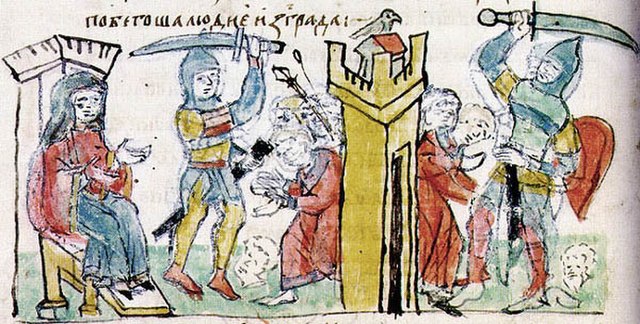
Radziwiłł Chronicle. Olga’s revenge to the Drevlians, 15th C. public domain

As part of an ongoing feud with the Drevlians (a nearby tribe), Igor was eventually “captured by them, tied to tree trunks, and torn in two.” This set a chain of cunning and violent revenge from his widow that would cause much more horrific bloodshed.

The Radziwiłł Chronicle is a later copy of the Primary Chronicle, with more added to it, and has a whole heap of illustrations. As a fan of the style of medieval manuscript, this does not disappoint. I like to narrate them. In the series about Olga, she is usually sat pointing at the events, which I may have mimicked from my office chair. But you can’t prove it! Here she is chilling and saying “ah yes, burn them to death”. If you scroll back up she’s saying – no wait, I can’t tell you that bit yet, it’s for later.

Radziwiłł Chronicle. Olga’s revenge to the Drevlians, 15th C. public domain

Her story is one of those where it baffles me that it isn’t more well known. Even from the cold commercial point of view – it would make a brilliant TV series or film. In a talk recently I mentioned truth being stranger than fiction, and this is one where you don’t need to make it up – as you have it here ready to go! Chronicled!

Perceiving a weakened widow, the Drevlians offered to marry to her to their own prince, Prince Mal. She replied enthusiastically, of course she would, she can’t just be floating around unmarried after all and she was now a free lady! She specified that they must come via boat, and would be carried by her people as an act on honour. How lovely.

St. Olga of Kyiv. Drawing for mosaic by Nicholas Roerich, 1915

When they arrived, they were indeed all lifted up, which must have been a nice treat. However they were then tipped into a pre-dug hole and buried alive. Oops.

Her justification was that they didn’t send particularly high ranking or “cool enough” men, so they should do that and then she will totally comply. Totally. Upon arrival she had them led into a bathhouse for a nice scrub, which was then locked and set on fire. What’s the old saying – fool me once, shame on you, fool me twice….won’t get fooled again?

Still, they agreed to her third demand, which was a mighty feast where she could weep over the tomb of her husband, and finally accept that she had to remarry. Psyche! After they were all drunk on mead, her people killed around five thousand of theirs.

You’d think after this, that all pretence would be expired. But you’re already admiring this BEAUTIFUL collage I just made, and thinking that perhaps that cannot be the case. An attack on Iskorosten was declared by her young son, Sviatoslav, who feebly threw a spear (bless him!) towards the Drevlian forces on her command; this siege lasted a year.

After the year, she said, “Ok, here’s the deal. You just need to pay us tribute. All we want is three pigeons and three sparrows from each household, and that’ll be fine.” Presumably forgetting not to trust this lady at all, they complied. Seems reasonable enough!

“Fly my Pretties” by Annie Norman, 2024

“Annie, why have you collaged a pigeon flying in fire, whilst also carrying some fire?” Just normal reasons. They gave her the birds and off she went, it was all fine. Nobody die- ok fine, lots of people died. Each pigeon and sparrow had a little piece of sulphur and cloth tied to it’s little leg and set free. Yay! Of course they are homing animals, so off they go back to the city to go nest in all the lovely flammable hay and yes the whole place is on fire.

These intros to the Community Miniatures are supposed to be, well, intros. Brief. But we’re getting on a bit more so I’ll fast forward. Olga does a lot of work regarding administration, law making and changing the tribute system, which is fascinating in it’s own right, but has no flaming birds.

So, around 950 CE her travels took her Constantinople, where she caught the eye of the emperor, Constantine VII. Olga was still a highly sought after widow, and after many years of dodging proposals, she was running out of excuses. She had Constantine baptise her under the Christian name Helena, and then said oh no we can’t marry now it’s too weird. (The term used is “spiritual incest”)

You’ll have to look up the rest! She was later on made the Patron Saint of Widows and Converts, the former being obvious and the latter due to her vast work spreading the word of Christianity.

Now how the heck are we going to sum all this up in one mini? Stay tuned….

-Annie

Designing Jeanne d’Arc

So here we go! If you missed Part One, check this out first. What do we know, first of all? Well, she wore men’s clothes. She has been depicted in dresses and skirts, but that’s more the symbolism, and we want to go as accurately as we can. I also wish to make figures that the historical person would approve of if they could see it somehow; come on Bill and Ted – lend me that time machine! She DIED because of her insistence on men’s clothes, so she’s getting them in 28mm! We won’t give her a helmet as we want to see her face, the face that grown men would have seen on the battlefield.

John Everett Millais – Joan of Arc, 1865, Very much in the Pre-Raphaelite style

In the variety of depictions, Jeanne has much in common with Eleanor of Aquitaine. They’re both shown highly stylised and dressed in what was a fashionably romanticised notion of her period at the time. I see this as a positive; you can see how they evolve over time yet keep the same key components, such as the banner and armour, in Jeanne’s case. It’s not historically accurate, but it is an insight into history in its own way.

I know some folk will want to see her hacking and slashing her way up a rampart, but this also goes against Jeanne’s position. I, too, wish to see more hack-and-slash medieval ladies, but you have to vote for them! We do have Jeanne de Clisson currently, but more would be a dream. Jean Hatchett very closely made it last time, perhaps on the next voting rounds? As I mentioned in the Eleanor of Aquitaine post, it’s good to keep them as much “themselves” as possible, instead of putting them into a different role.

To the Armouries!

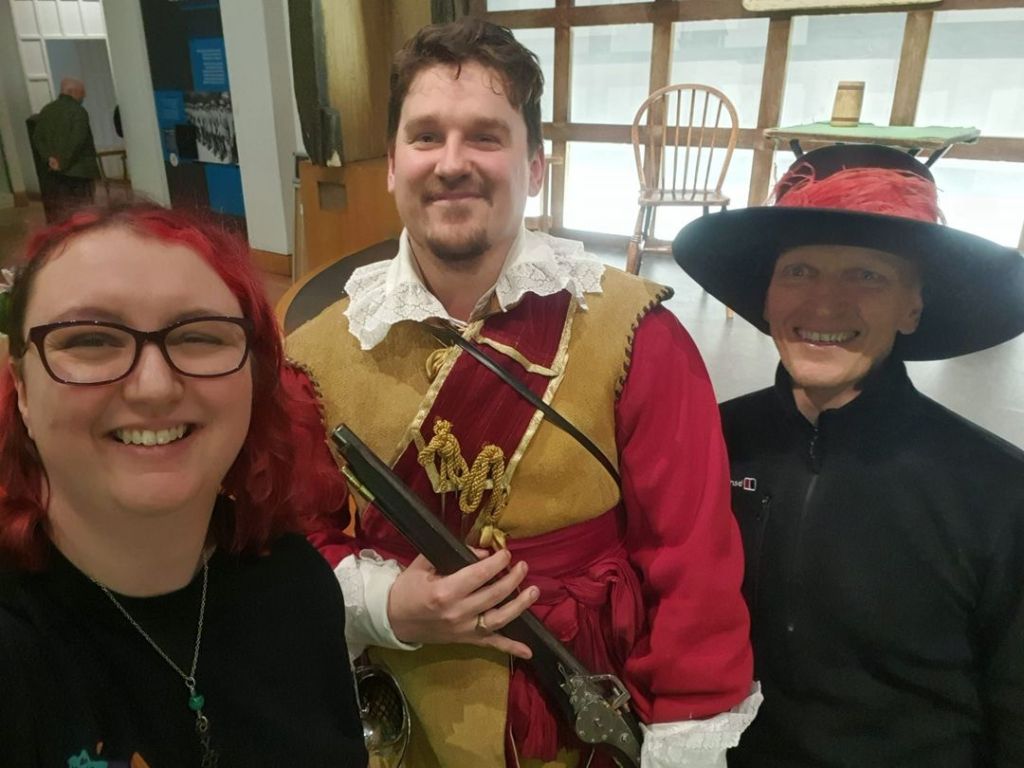
After giving myself a headache looking at all sorts of armour, I decided to go to The Royal Armouries in Leeds for some hands-on research. Sculptor Alan Marsh came along!

L-R Me (Annie), Richard of ECW knowledge, and Alan: not his usual hat.

It was a superb chance to catch up and nerd out with many history chats over coffee and a delicious roulade. For a second time, I was impressed by how many books about women in history the gift shop has, which is even more than last time I was there. Of course, I had to buy some…

It’s brilliant to discuss upcoming figure design while in front of the actual pieces and, of course, feel the weight of different weapons. This all helps with the sculpting process to bring you these awesome-cool minis.

The Banner

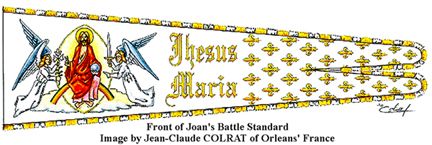
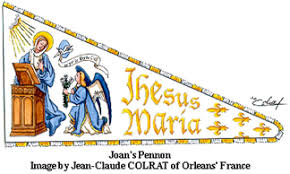
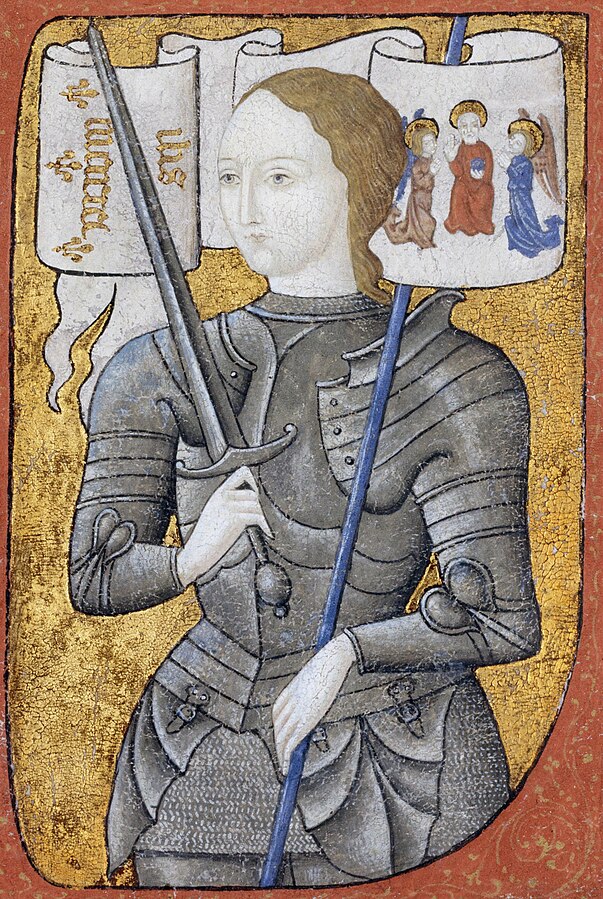
Essential in Jeanne’s “kit” is the banner. She had several; important ones for us are the battle standard and the pennon. The battle standard was enormous and too unwieldy on foot, requiring a special saddle to prop it in. If we make a mounted version (I really want to, please buy loads of this to convince me!) we will use that for sure.

The pennon is the foot version, carried on a shorter pole and what she would have had to be mobile without her horse. With the mega battle standard, she wouldn’t be able to walk about.

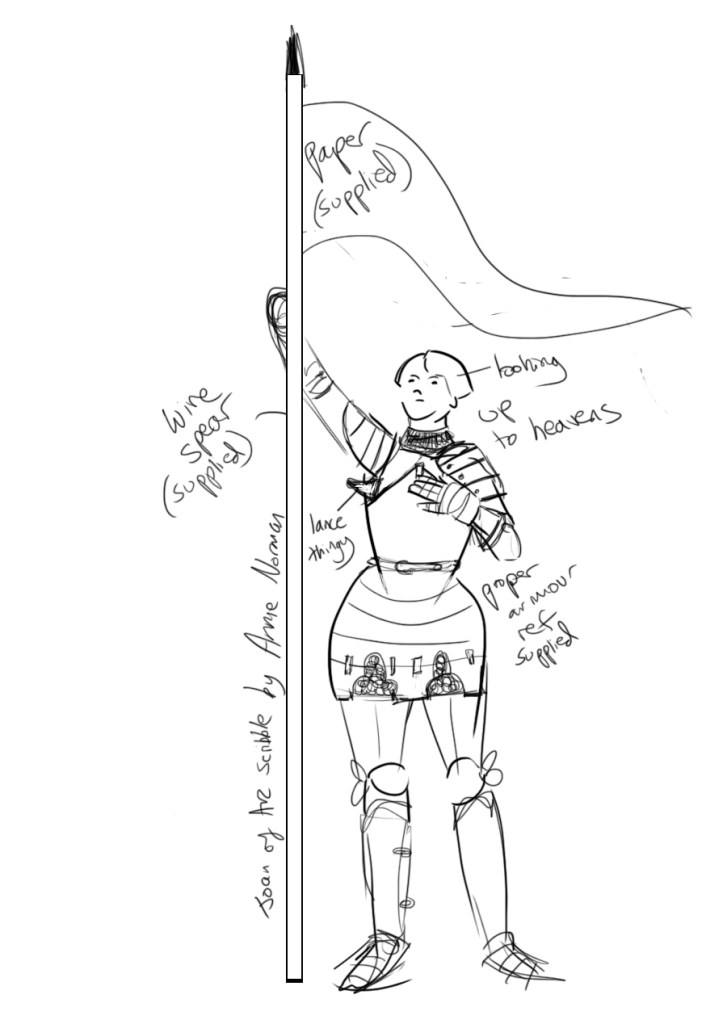
When considering the pose, I figured that even though this is smaller, she would probably not be strong enough to hold it in the air one-handed, so it will be resting on the ground.

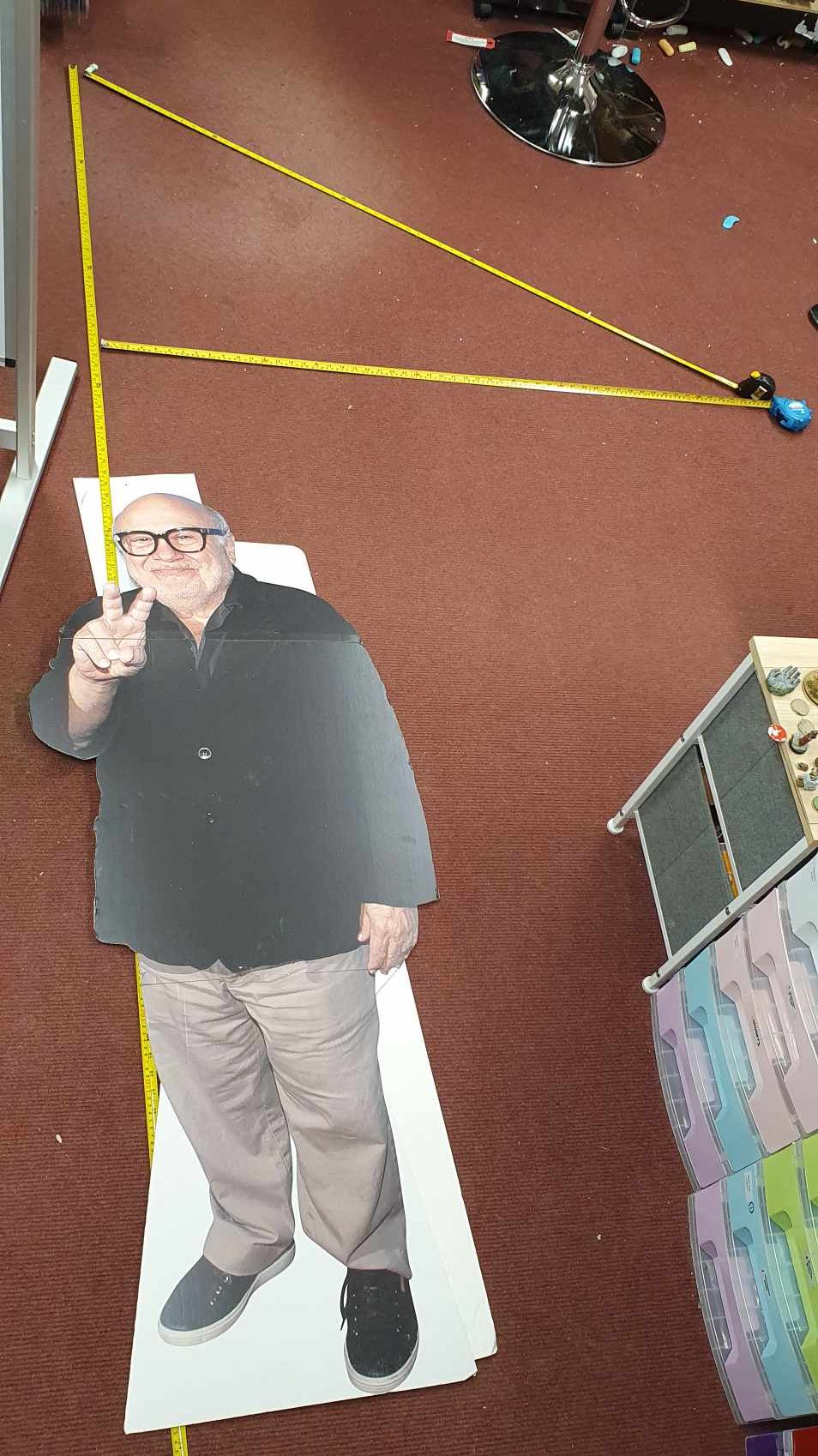
I found the measurements of both flags, so first I lay out the size of the pennon and needed something to help scale, and who better than Danny Devito?

There’s always a debate between cast banner and wire spear with transfer/paper. I have mulled this over for A LONG TIME. Cost is a significant factor, with these minis being £5 each, a big wavy bit of metal adds to the cost considerably. They can also become really clunky. I really want people to have their own unique Jeanne banner, and not a generic 15th century knight, so considered the possibility of getting a transfer made, but this is hard to apply along folds and creases of something sculpted.

Then, I mucked about with a wire spear and the paper we use for leaflets which found it to be a perfect thickness. I never did understand applying transfers to paper, when you could just have the paper printed in the first place. This would be a better quality than standard printer paper as well. So it’s now escalated to pricing up what the cost of our own designed pennon AND battle standard would be, as we might as well do both simultaneously, right! That mounted figure is happening whether I like it or not, isn’t it… (ha I protest too much for sure).

“I love my banner best – oh, forty times more than the sword! Sometimes I carried it myself when I charged the enemy, to avoid killing any one.” – Jeanne during her Trial.

Armour

Figure Design by Annie Norman, 2023

Several contemporary references to Jeanne being in “White Harness” armour exist. The white part means that it wasn’t embellished (Sorry Millais) and the harness part is that it is in many separate pieces. Jeanne was first given an “all in one” armour, then used some found Burgundian armour, and then was eventually commissioned this lovely piece by Charles VII. So that’s what I want to put her in.

It’s important to me that the pose is very much lifting the eyes upwards; Jeanne is holding the banner as high as she can so everyone can see, and she’s looking to the heavens for reassurance. These are all little signs that it is Jeanne d’Arc.

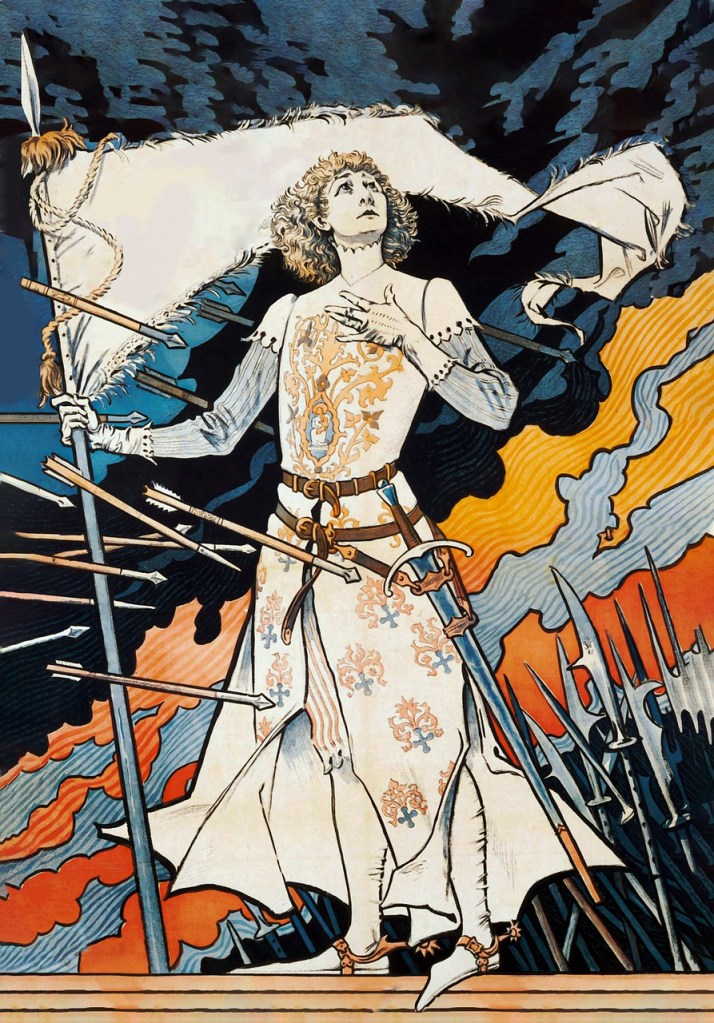
The hand-on-chest pose is used in several of the paintings and statues, and I appreciate the gentleness of it. However, in these, she is often shown bare-handed, I hope the gauntlets still have the same effect!

Eugène Samuel Grasset version of Jeanne

Something missing from my scribble is… The Holy Sword! That will be hanging from the scabbard, sheathed. Jeanne’s sword was the “Sword of St. Catherine”. A companion of Joan’s on the way to Orleans said, “I wanted to sharpen that old blade, but she said it was not necessary, as she should never kill anybody, and should carry it only as a symbol of authority.”

For the hair, we’re going for a shaggy bob, again to stand out more than a full “short back and sides”. This is one of the artistic decisions to make minis less literal sometimes, but not too far off reality – for example long flowing locks would be far off! A grown-out, super short hairdo is more justifiable.

I’m cutting this short as I feel like I’ve lived non-stop Jeanne for the last month and there is SO MUCH more I could write, but we’re nearing the end of the calendar year and I am sleepy, with more blog entries to complete!

The goal is to have these last two sculpted by the end of the week (ish) and then we can get voting on the next two between Christmas and New Year. Hooray!

What did Jeanne d’Arc actually do?

Here we go. Strangely, this is the figure I am most nervous about designing so far. Joan of Arc, or Jeanne d’Arc is known and beloved by many, and perhaps THE most famous military woman in history, if not a solid top-five contender! She’d be a winning answer in Family Fortunes.

Jeanne D’Arc being excellent

The nerves come from this, that people have their own idea of who Jeanne was, what she did, and what she looked like. She’s a household name and has been portrayed in so many movies (of course, most memorably in Bill and Ted’s Excellent Adventure), some more faithful to historical records than others.

Jeanne d’Arc was born in 1412 CE, during the Hundred Years War, a long and bloody conflict between England and France, which she would be destined to shape. From a young age, she began hearing what she believed to be the voice of God, though there are attempts at modern diagnosis to explain this on a secular level. We will never know, as per the words of Ridley Scott “Were you there mate?”

This led her on an incredibly daring mission to ensure that Charles VII (currently the dauphin) was to be crowned King, and then his army could save France. The fact that a young girl could walk up to somebody so high ranking is wild enough, but the fact they [eventually] paid attention is even more fantastic. “Scuse me, Sirs, you’re doing war wrong”.

Jeanne led the French Army through highs and lows in the pushback against the English, becoming a mighty hype for morale, waving her banner and yelling for them to push on. An army believing they have God on their side is exceedingly powerful. While it was unlikely she would have fought intentionally, due to her age, size, and lack of combat training, Jeanne’s presence and encouragement were where her power really lay. In wargames, we have rules such as “Inspiring Presence” for banner bearers, and it really was just that!

Jeanne as portrayed by Milla Jovovich in “The Messenger”, 1999

After a defeat at Margny, she was captured, after pretty much being abandoned by the King she helped create and put on trial by a mixed jury of French, English, and their French allies – the Burgundians.

The trial was as you can imagine – incredibly unfair. However, Jeanne was brilliant (the record of the trial is actually online) and managed to make it through the thorough questioning. What I find bizarre, about the entire odd tale, is they effectively “got her” in the end for her trousers. She insisted on wearing men’s clothes to show she was a soldier, the same as others, and under the direction of God. Crossdressing was seen as blasphemous so she was sentenced to death. Refusing to refute her Mission from God, Jeanne d’Arc was burned to death before a public audience on May 30, 1431, aged just 19.

I normally keep these summaries reasonably brief, to encourage people to read more, but there’s a bit more this time. Sometimes a story or figure can become so well-known that you actually forget the details. So there’s a refresher! There is course far, far more to the story, but that’s the jist!

Designing Jeanne d’Arc

You know what? I’m putting this into the next entry, as this is fairly long, and I have a BIT more research to do. Keep them hungry, as they say!

-Annie.